What Fractional CTO Rates Actually Look Like in 2026-2027
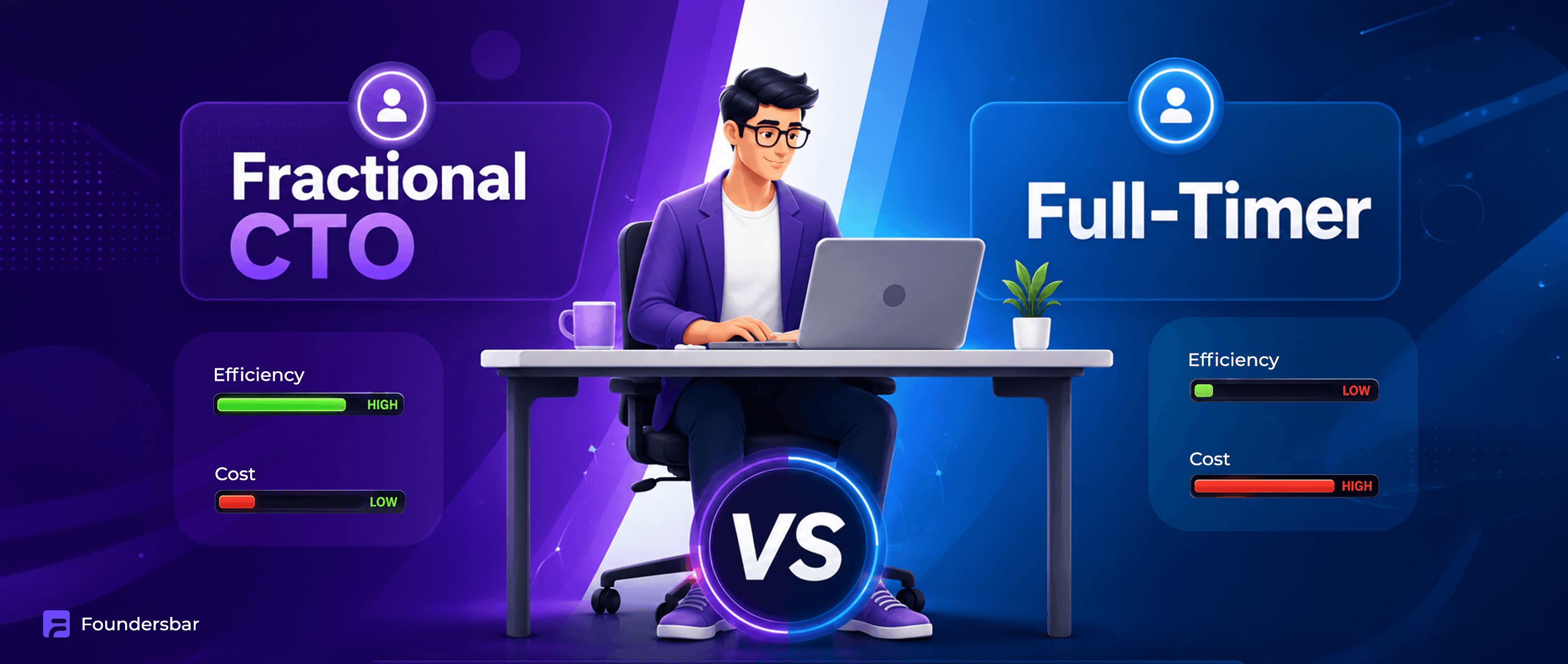
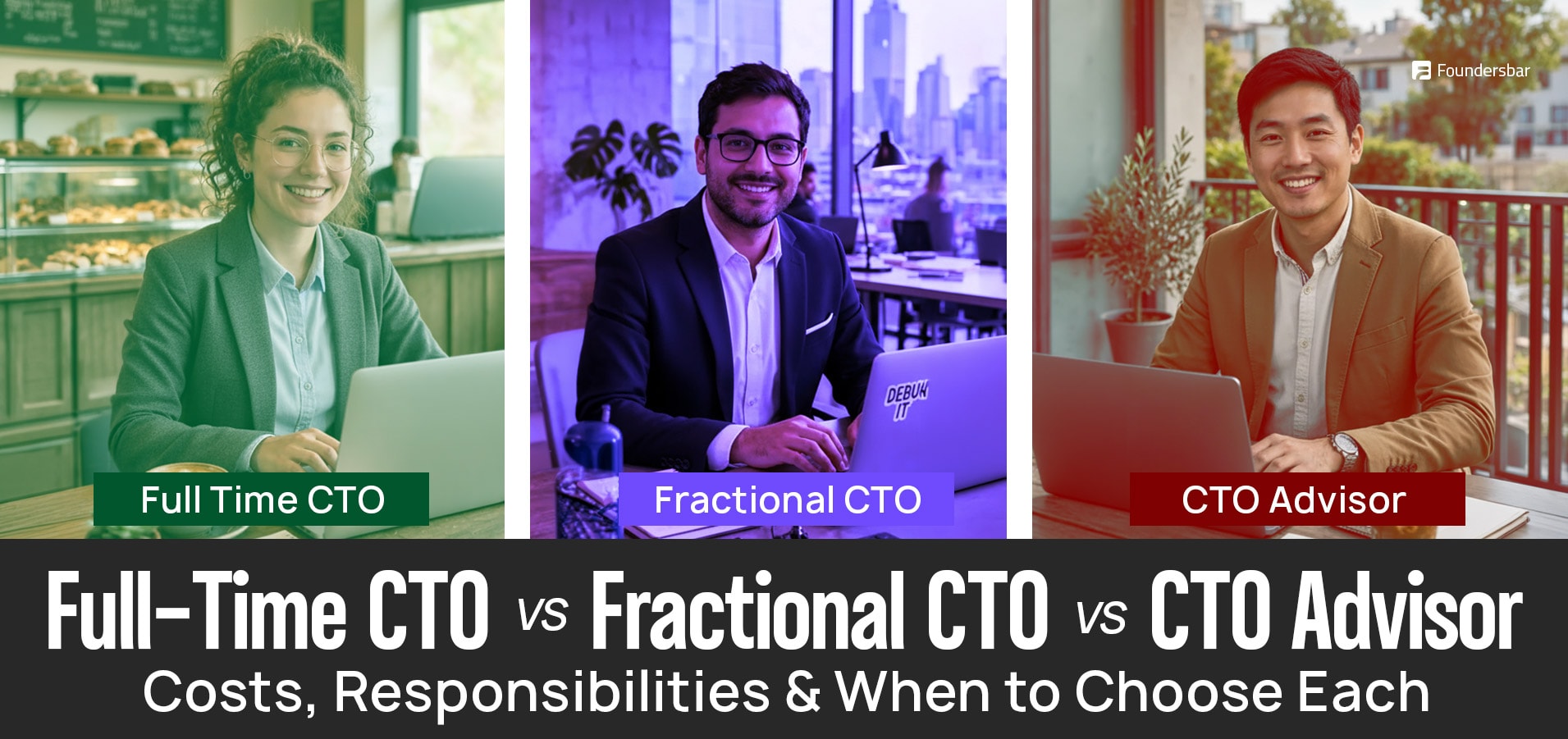
Once a founding team accepts that promoting the first strong developer is usually the wrong move, the next practical question is cost. What does senior technical leadership actually cost in the US in 2026-2027 if you are not ready (or able) to hire a full-time CTO? This piece focuses on the numbers: Fractional CTO rates, typical engagement models, full-time CTO compensation by market tier, and a clear decision framework for choosing between the two.

Fractional CTO Rates in the US (2026-2027)
Market data from multiple 2026 sources shows a consistent picture for senior, experienced fractional CTOs in the United States.[1][2]
- Hourly rates typically sit between $150 and $400. The practical working range for operators with real startup and scale experience is roughly $200-$275.[1][3]
- Monthly retainers for 10-20 hours per week commonly fall between $5,000 and $15,000. Heavier or specialist engagements (AI, security, deep architecture) run higher - sometimes $15,000-$25,000+.[2][4]
- Advisory-only engagements (a few hours per month) can start lower, around $2,000-$5,000, but these deliver limited decision leverage.
The model that works best for most early-stage teams is a predictable base retainer plus the ability to flex hours when a critical decision, hiring sprint, or vendor evaluation appears.
Full-Time CTO Rates by US City Tier
Full-time CTO compensation varies significantly by location, company stage, and equity component. Below are approximate 2026 ranges for base salary in major US markets. Total compensation (including equity and bonuses) is typically 30-100%+ higher depending on stage.[5][6]
Tier 1 - Premium Markets
San Francisco Bay Area (San Francisco, San Jose), New York City, Seattle, Boston
- Median base: $340,000 - $390,000
- Typical range: $300,000 - $450,000+
- High end (senior / late-stage): $500,000 - $700,000+ total compensation is common once equity is included.[5][7]
Tier 2 - Strong Secondary Markets
Austin, Denver, Chicago, Los Angeles, Dallas, Atlanta, Washington DC
- Median base: $300,000 - $340,000
- Typical range: $270,000 - $380,000
- High end: Can reach $450,000-$600,000 total at well-funded growth-stage companies.[5][6]
Tier 3 - Emerging & Lower-Cost Markets
Nashville, Raleigh-Durham, Miami, Salt Lake City, and many secondary metros
- Median base: $280,000 - $310,000
- Typical range: $240,000 - $340,000
Note: Talent pools for true multi-cycle CTO experience are thinner; companies often pay closer to Tier 2 rates to attract proven operators.
Fully loaded first-year cost (base + benefits + equity value + recruiting) for a full-time CTO in major markets frequently lands between $470,000 and $690,000+.[2][8]
How to Decide: Full-Time vs Fractional CTO
The right choice depends on stage, team size, complexity, and capital position - not on a generic “best practice.”[9][10]
Choose Fractional When:
- You are pre-seed to early Series A and still proving product-market fit.
- Your engineering team is under ~10-15 people.
- You need senior judgment on architecture, hiring, and make-vs-buy decisions, but do not yet need daily executive bandwidth.
- Cash is constrained and you want to avoid a 3-6 month search plus a high fixed cost.
- You want a clean off-ramp if the relationship is not working.
Choose Full-Time When:
- The engineering organization requires continuous day-to-day leadership, performance management, and rapid hiring velocity.
- You have 15+ engineers (or multiple teams) and the coordination load has become full-time work.
- You are post-Series A / growth stage with the capital and brand to attract and retain a true executive-level CTO.
- Technology is the core differentiator and you need someone fully embedded in the technical details every day.
A common high-leverage path is to start with a strong fractional CTO, use that person to raise the quality of early decisions and hires, then transition to a full-time CTO when the organization and capital position justify it.[9][10]
Why Fractional CTO Capacity Is Usually the Higher-Leverage Move Early
Most non-technical founders do not fail because they lack developers. They fail (or burn capital) because early technical decisions and hires compound in the wrong direction.
A fractional CTO who has lived through multiple cycles brings pattern recognition that a first-time technical lead simply does not have. That judgment is applied precisely where it matters most - architecture, hiring quality, vendor leverage, and the balance between short-term delivery and long-term optionality - without the full fixed cost of a permanent executive seat.
If you are currently operating without that senior technical sparring partner, the cost of continuing without it is usually higher than the cost of putting the right fractional capacity in place.
Go Fractional. “Fractional CTO Benchmarks (2026).” Average observed rate $216/hr; 25th-75th percentile $150-$250/hr. [Link]
CTO On Demand. “How Much Does a Fractional CTO Cost in 2026?” Typical range $200-$400/hr or $5,000-$15,000/month retainer. Fully loaded full-time comparison included. [Link]
FractionalCXO.to. “Fractional CTO Cost 2026: Rates & Pricing Data.” Retainer range $5K-$18K/mo; cost savings vs full-time often 35-65%. [Link]
A.Team Talent Guides. “Fractional CTO rates in 2026.” Advisory $4K-$10K/mo; active fractional $10K-$25K/mo. [Link]
DataDrivenDaily. “CTO Salary US 2026: What Tech Leaders Earn by City and Company Size.” City-level averages including San Jose ($390k), San Francisco ($386k), New York ($358k), Seattle ($342k), Austin ($306k), Denver ($315k). [Link]
Salary.com / Comparably / SalaryOptics (2026 aggregates). National and city-level CTO base and total compensation data confirming Tier 1 premium of 15-25%+ over national averages.
Comparably. “Chief Technology Officer CTO Salary - July 2026.” National average ~$277k base; San Jose total compensation significantly higher. [Link]
Multiple 2026 analyses (CTO On Demand, FractionalCXO, Continuum). Fully loaded Year-1 cost of a full-time CTO in major US markets frequently $470k-$690k+ once benefits, equity, and recruiting are included.
HyperNest Labs. “When to Hire a CTO vs Fractional CTO (2026 Decision Guide).” Stage- and team-size-based framework favoring fractional for pre-Series A teams under ~10 engineers.
Rewired / Particle41 / Traztech / Numen (2025-2026). Consistent decision frameworks recommending fractional CTO until team size, organizational complexity, and capital position justify a full-time executive seat.
Thinking about building a product or taking it to market?
Thinking about building a product or taking it to market?
Thinking about building a product or taking it to market?
Thinking about building a product or taking it to market?