What Does a Fractional CTO Do (and Not Do) for Startups
A practical guide to understanding what a fractional CTO does for startups, from setting technical strategy and making architecture decisions to hiring engineers, managing vendors, and preparing for investor diligence. Learn how the role differs from a full-time CTO or technical advisor, when to hire one, what they should not handle, and how responsibilities change as a startup grows.

What Does a Fractional CTO Do (and Not Do) for Startups
Founders usually ask the wrong first question. They ask whether they need a CTO. The useful question is what work is actually sitting on the table: architecture calls that are expensive to reverse, hiring the first engineers without getting played by a polished resume, and telling investors something true about the stack. That is the job a fractional CTO is built for.
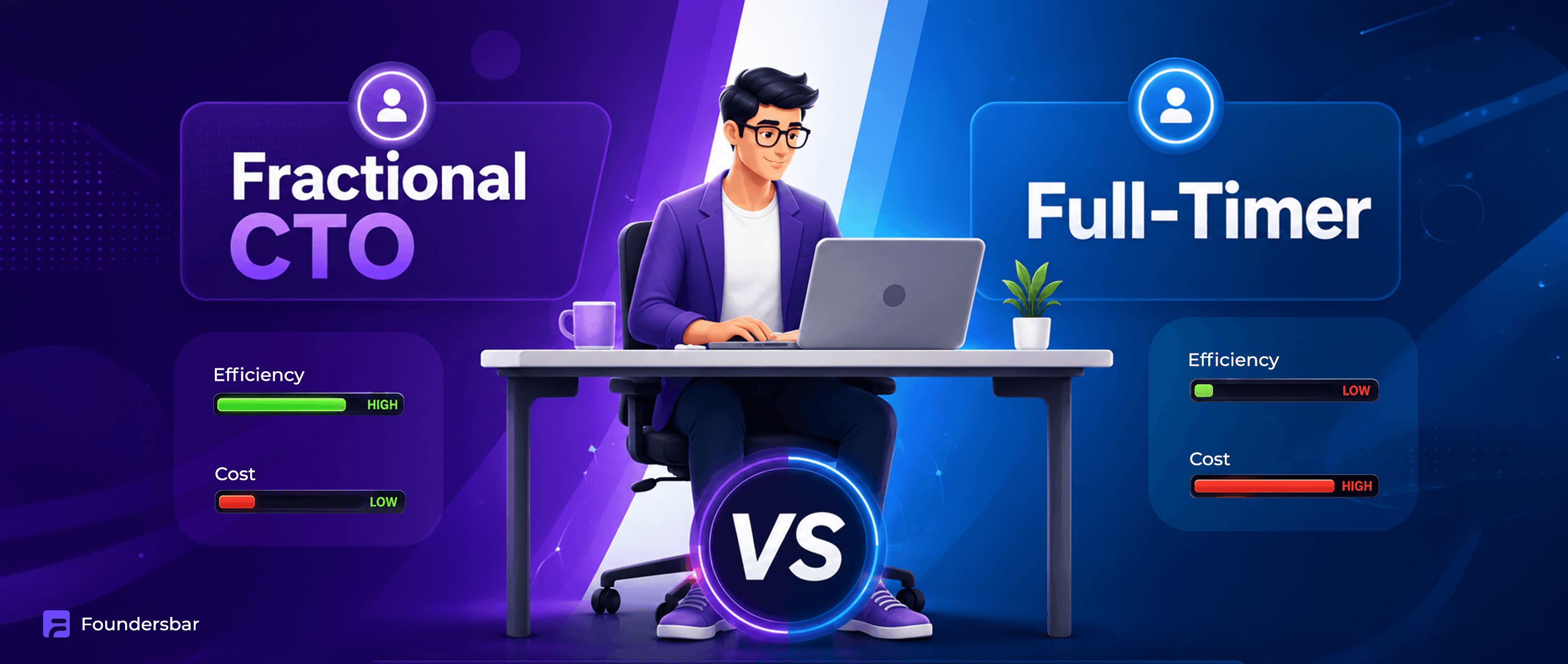
The confusion around the title is not marketing noise. A full-time CTO owns the technology function five days a week, sits in every incident, and builds culture over years. A technical advisor takes a monthly call and gives opinions. A fractional CTO sits between those two. They work a slice of the week, usually on a retainer, and they own decisions inside an agreed scope. They are not a cheaper senior developer. They are not a board-level name on a slide.
If you mix those three roles up, you either overpay for presence you do not need or under-buy the authority you do need. This article explains what a fractional CTO actually does for startups, what they do not do, how the work changes from pre-seed to Series A, and when the hire is worth the retainer.
What Is a Fractional CTO?
A fractional CTO is a senior technology leader who works with a company part-time, typically 10 to 25 hours a week, on a monthly retainer. They take the same class of decisions a full-time CTO would take: stack and architecture, engineering hiring bar, vendor and build-versus-buy calls, security baseline, and the technical story investors will test. They do it without a $250,000 to $400,000 salary, an equity grant, or a six-month search.
The word that matters is ownership. Consultants write a report and leave. Advisors give perspective. A fractional CTO is inside Slack, in planning, on hiring loops, and on the hook for the roadmap they set. They usually work with more than one company at a time. That is the trade: you get pattern recognition from several startup cycles, and you give up exclusive calendar access.
Typical engagement length is six to eighteen months. The clean version of the role ends in one of three ways: you hire a full-time CTO and they help with the handoff, you promote an internal engineering lead they have been coaching, or the company no longer needs executive technical bandwidth because the product and team are stable. If someone sells you a forever fractional seat with no exit criteria, treat that as a warning.
What a Fractional CTO Actually Does
The work is decision-heavy, not ticket-heavy. Across early-stage startups the same ten responsibilities show up again and again.
- Set the technical strategy and roadmap. Turn business goals into a 6 to 18 month engineering plan. Sequence work by dependency and risk, not by whoever shouted last in the product meeting.
- Make architecture decisions that are expensive to reverse. Cloud, data model, API shape, monolith versus services, auth, and how you will handle the first real scale event. These are the calls that either save a rewrite or force one.
- Choose the stack and draw build-versus-buy lines. Founders over-build. Agencies over-sell platforms. A fractional CTO picks tools the team can actually hire for and maintain, and kills features that should be a vendor.
- Run technical hiring. Write the job, set the bar, screen resumes, run the system-design interview, and make a hire or no-hire call. Your first three engineers set the next two years of quality. Non-technical founders cannot evaluate that bar alone.
- Put engineering process in place. Code review, CI/CD, release cadence, on-call basics, and a definition of done the team can keep. Not a 40-page playbook. The minimum process that stops you shipping by heroics.
- Audit vendors, agencies, and the tool stack. Review agency output, renegotiate or cut SaaS spend, and stop paying two tools for one job. Early teams leak money here because nobody senior is looking at invoices.
- Set a security and reliability baseline. Access control, backups, secrets, logging, and the unglamorous work investors will ask about in diligence. Not a SOC 2 project on day one. The floor that keeps you from becoming a headline.
- Rank technical debt and decide what to ignore. Every codebase has debt. The job is naming what will break the next fundraising or the next 10x of users, and leaving the rest alone so the team can ship.
- Translate engineering to the CEO, board, and investors. Write the technical section of the deck, sit in diligence, and answer scale and IP questions without hedging. If the founder cannot defend the architecture in a partner meeting, the raise gets slower or smaller.
- Coach the senior engineer who will eventually replace them. A good fractional CTO is trying to work themselves out of the seat. They document decisions, raise the internal lead, and leave a function, not a dependency.
Day to day that looks like founder 1:1s, architecture reviews, candidate interviews, vendor calls, and a weekly written status. It does not look like eight hours of production tickets.
What a Fractional CTO Does NOT Do
This section is the one founders skip, then complain about six weeks later. Write these boundaries into the statement of work.
- They do not write most of the product. If you need features shipped 30 hours a week, hire engineers or an agency and have the fractional CTO oversee them. A person billing executive rates to close Jira tickets is a mis-hire with a fancy title.
- They are not on-call at 2 a.m. as a default. They can set the incident process and join a real outage. They cannot be the pager for three clients. If you need 24/7 coverage, buy that separately.
- They do not replace a VP of Engineering. CTO work is direction, architecture, hiring bar, and external credibility. VP Eng work is sprint flow, performance management, and daily delivery. Past a certain team size you need both, or you need the internal lead to own delivery.
- They do not own product management. They will kill technically stupid roadmap items. They will not run user research, write the PRD, or decide pricing. That is a product job.
- They do not do IT support. Laptops, email, SSO tickets, and printer myths are an MSP or an office manager problem. Do not burn a $200-plus hour on that.
- They do not fix a broken business model. If customers do not want the product, better Kubernetes will not help. Technical leadership cannot substitute for distribution or a real wedge.
- They do not give you exclusive access. They split the week. Response times should be contracted. Instant availability for every Slack ping is a full-time hire.
- They are not a technical advisor with a louder title. If the person will not own decisions, will not interview candidates, and will not put their name on the architecture, you hired an advisor. Pay advisor rates.
- They are not a permanent fixture by design. The point is to stabilize decisions, raise the team, and either hand off to a full-time CTO or make the internal lead sufficient. An open-ended retainer with no success definition is how the model quietly turns into expensive habit.
If your actual need is code output, hire builders. If your actual need is a monthly sanity check, hire an advisor. Use a fractional CTO when the bottleneck is judgment, not hands.
Fractional CTO Responsibilities by Startup Stage
The title stays the same. The calendar does not. Hours and focus should move with stage. Treat the ranges below as planning defaults, not a contract.
At pre-seed, 8 to 15 hours a week is usually enough if the person can make calls and then get out of the way. At seed, 10 to 20 hours is the common band because hiring and oversight eat calendar. At Series A, either increase hours for a defined scaling period or start the full-time search. If you still need a fractional CTO to approve every pull request at 15 engineers, you do not have a leadership model. You have a bottleneck you are renting.
Fractional CTO vs Full-Time CTO vs Advisor
Use this as a filter. If you want the longer breakdown, read the full comparison article: [link to your bigger comparison article].
The failure mode is hiring an advisor when you need someone to reject a bad hire and stop a rewrite. The other failure mode is hiring a full-time CTO when you have four engineers and a roadmap that does not fill a senior executive week. Empty calendar at that level creates politics and invented process.
How Much Does a Fractional CTO Cost?
Treat published rates as ranges, not a sticker. In the 2026 US market, experienced fractional CTOs commonly bill in the $170 to $400 per hour band, with many retainers landing between $5,000 and $15,000 a month for roughly 10 to 20 hours a week. Lighter advisory seats can sit under $5,000. Heavy or near-interim work can run $15,000 to $25,000 or more. Specialists in regulated industries or deep AI platforms charge at the top of the range.
Compare that with a full-time CTO correctly. Base salary is often quoted at $250,000 to $400,000. Add payroll load, bonus, recruiting fees, ramp time, and equity, and year-one cost is frequently much higher than the salary line. Fractional looks expensive per hour and cheap per year if you only needed a fraction of the week.
Price should follow scope. Pay for roadmap ownership, hiring, and architecture. Do not pay executive rates for ticket throughput. Get hours, decision rights, response expectations, and an off-ramp in writing. For current packaging and what is included in an engagement, see the Fractional CTO Services page: [link to your service page].
When Should You Hire a Fractional CTO?
Hire one when the constraint is senior technical judgment and you cannot keep a full-time executive busy without inventing work. Common triggers:
- Non-technical founders are making stack and hiring calls. That is how you end up with an unhireable codebase and a senior engineer who looks good on LinkedIn and cannot design a system.
- An agency or contractor team is building the product with nobody qualified reviewing it. You need an owner on your side of the table, not another vendor.
- A technical co-founder left, or was never there. You need coverage in weeks, not after a two-quarter search.
- A raise is coming and the architecture cannot survive a competent diligence call. Do this before the data room, not during it.
- The senior engineer is doing two jobs. They are shipping and pretending to be CTO. That person burns out or starts making timid architecture choices. Take the executive load off them.
- Cloud and SaaS spend is rising faster than usage. Someone who has seen the invoice pattern before will cut faster than the team that bought the tools.
Do not hire one if you only need code written, if you already have a strong CTO, if the company has no real technology dependency, or if leadership will not act on recommendations. A fractional CTO who cannot get a decision through the founder is decoration.
A practical test: list the next 90 days of irreversible technical decisions. If that list is empty, you may only need an advisor or a tech lead. If that list is long and nobody in the company is qualified to make those calls, the retainer is cheaper than the rewrite.
A fractional CTO is part-time executive technical leadership with ownership, not a rented coder and not a monthly pep talk. They set strategy, make the hard architecture and hiring calls, keep vendors honest, and make the company legible to investors. They do not replace the engineering team, the product function, or a full-time CTO once the org is large enough to need one in the building every day.
Get the scope right and the model is straightforward: buy judgment for the stage you are in, write down what they will not do, and plan the handoff from day one. Get the scope right and the model is straightforward. Get it wrong and you will pay senior rates for work a mid-level engineer should have done, or you will hire an advisor and wonder why nothing moved.
If you are an early-stage startup trying to decide whether this seat is real work or just a fashionable title, start with a scoped conversation about your current stack, team, and next raise. See Fractional CTO Services to talk through fit, hours, and what the first 90 days should produce: [link to your Fractional CTO Services page].
Frequently Asked Questions
Thinking about building a product or taking it to market?
Thinking about building a product or taking it to market?
Thinking about building a product or taking it to market?
Thinking about building a product or taking it to market?