Why Most Startups Hire the Wrong Tech Leader
The Non-Technical Founder Trap and How It Quietly Kills Early Momentum. A practical look at the most common (and costly) technical leadership mistake non-technical founders make.

The Biggest Tech Leadership Mistake Startups Make
Most startups are founded by people who understand the problem deeply - sales leaders, operators from manufacturing, domain experts who lived the pain their product solves. Technology is the means, not the starting point. Yet the moment the product becomes a technology solution (or the internal systems become a competitive lever), the question appears: “Who is our CTO?”
The default answer is usually the first strong developer the founders know. That decision feels pragmatic. It is often the most expensive mistake a nascent company makes.[1][2]
The Business Founder Trap
Business-function founders rarely have a reliable measuring stick for technical leadership. They can evaluate a salesperson by pipeline and close rates. They can evaluate an operations person by throughout and cost per unit. Evaluating a CTO requires pattern recognition that only comes from having seen multiple product cycles, multiple architecture decisions that aged well or poorly, and multiple hiring outcomes over a decade or more.
Without that lens, the founders promote the person who ships features fastest or who is most confident in meetings. Both are weak signals for the actual job.[3]
Why a Strong Developer Frequently Makes a Weak CTO
A competent senior engineer and a competent CTO optimize for different outcomes. The engineer optimizes for elegant code, clean abstractions, and personal mastery of the stack. The CTO optimizes for business outcomes under capital constraints: time-to-value, risk reduction, team leverage, and optionality.
Three common failure modes appear quickly:
- No measuring stick. Founders cannot distinguish between a developer who is merely fast and one who is making decisions that will cost six or seven figures later.
- The protection loop. Incompetent or insecure technical leaders tend to hire people less capable than themselves and select agencies that will not challenge them. The result is a closed system of mediocrity that is extremely hard to unwind.[4]
- Wrong default on make-vs-buy. Junior or mid-level engineers almost always default to “build.” An experienced CTO with 15+ years of cycles has seen enough expensive rewrites, vendor lock-in traps, and successful productized integrations to make the trade-off consciously.
Buy vs Make Decisions Require Scar Tissue
The CTO is usually the primary voice on whether to build a capability or buy (or rent) it. Early-stage teams under-index on the true cost of ownership of home-grown systems and over-index on the perceived control of building everything.
An experienced technical leader who has lived through multiple funding cycles knows:
- It is often correct to ship imperfect, even “bad” code if it generates revenue and learning. Perfect architecture that arrives six months late is frequently worthless.
- Buying has catches - data portability, pricing cliffs, roadmap misalignment, security surface - but those catches are knowable and manageable.
- The right long-term architecture is the one that still works when the company has 10× the customers and 5× the team, not the one that feels elegant today.
A good technical leader holds both the short-term cash reality and the multi-year technical vision in the same frame. That balance is rare in someone whose primary identity is still “senior engineer.”[5]
When You Actually Need a CTO
If your product is technology (or technology is the primary source of cost advantage or differentiation), you need senior technical judgment from the moment you start making non-trivial technical decisions. Waiting until you “can afford” a full-time CTO often means the expensive architectural and hiring mistakes have already been made.[1][6]
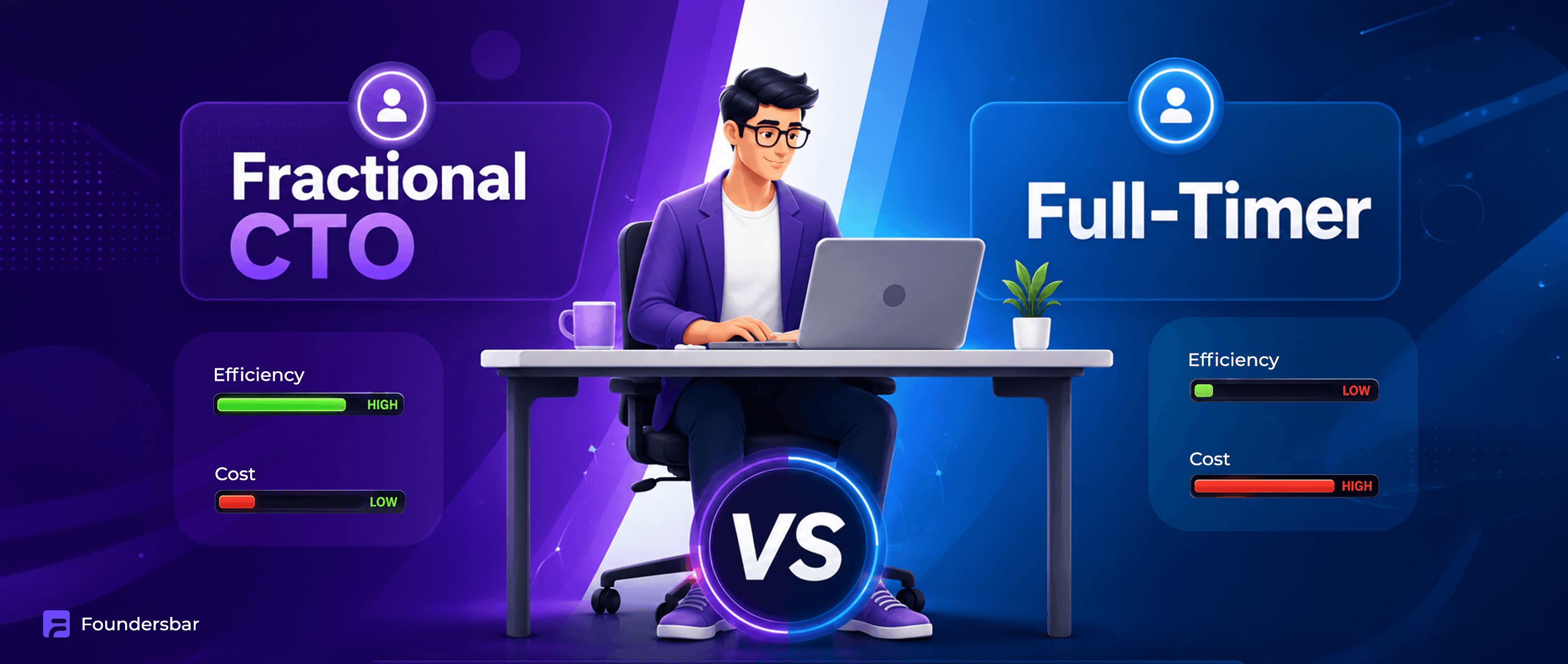
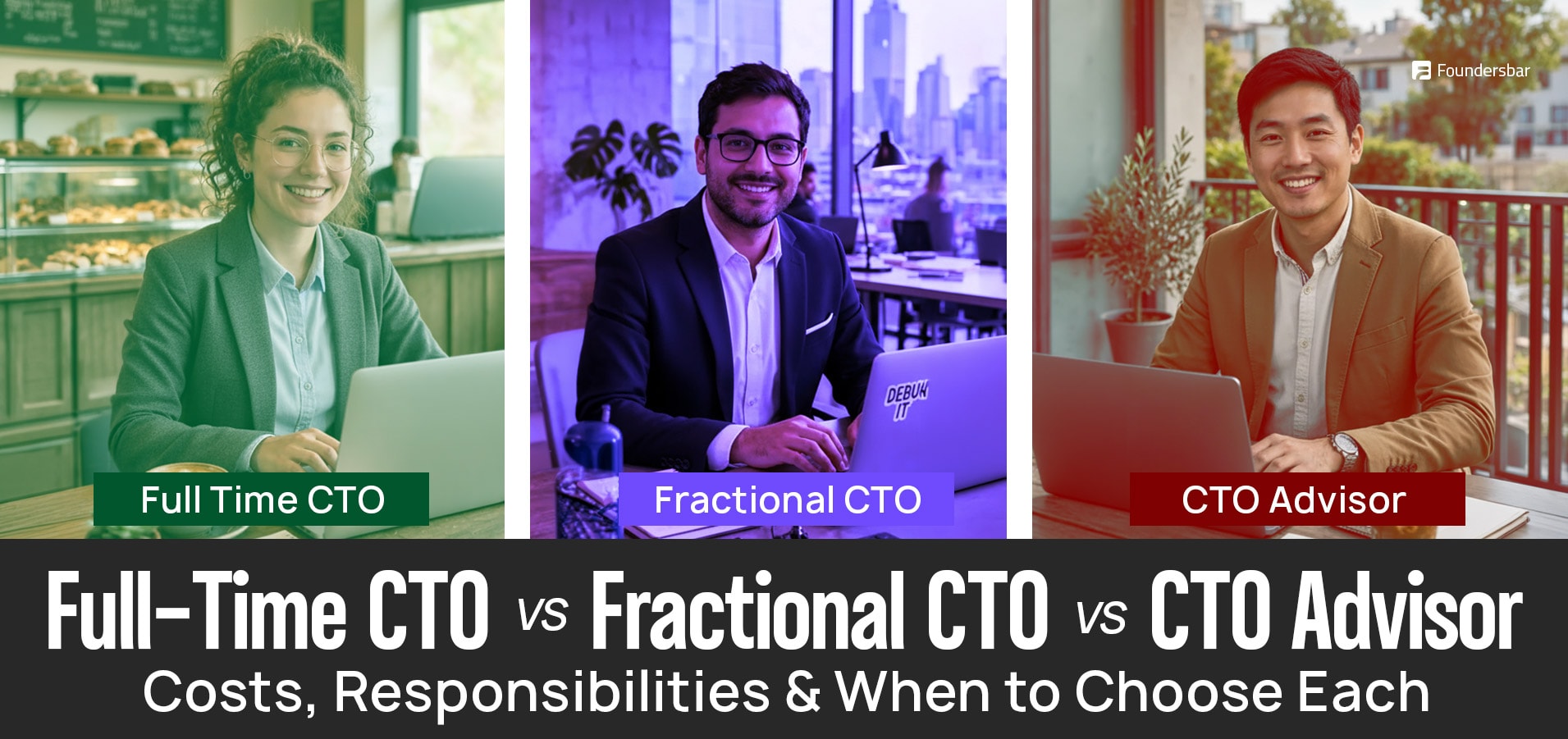
The practical question is not “CTO or no CTO.” It is “full-time executive versus fractional / wartime CTO.”
A full-time CTO is the right long-term structure once the engineering organization is large enough that daily leadership, performance management, hiring velocity, and cross-team coordination become full-time work - typically 10-15+ engineers and post-Series A capital. Attracting that level of talent also requires a real brand story and enough runway to be credible.[2][7]
Before that point, a fractional CTO (sometimes called a wartime CTO) delivers most of the strategic value at a fraction of the cost and with far lower commitment risk.[6][8]
What a Strong Fractional CTO Protects
Beyond pure cost, the right fractional CTO delivers:
- Hiring quality control. They sit in interviews, challenge inflated claims, and stop the “hire people who won’t outshine me” pattern.
- Vendor and agency leverage. They negotiate scopes, question estimates, and keep external partners honest.
- Architecture with an expiration date in mind. They know which corners can be cut now and which ones become permanent tax.
- Alignment with the other founders. A fractional CTO who understands capital constraints will push back on gold-plated solutions and support pragmatic paths that still leave the company investable.
The Practical Path Forward
For most non-technical founding teams building a technology product:
- Start with fractional CTO capacity as soon as technical decisions start compounding.
- Use that person to set the initial architecture direction, run the first critical hires, and establish basic engineering hygiene.
- Transition to a full-time CTO once the team size, capital position, and organizational complexity justify the full executive seat - and use the fractional relationship to de-risk that hire.
- It is always better to have a full-time CTO when the company can attract and retain the right one. Until then, a strong fractional CTO is usually the higher-leverage, lower-risk choice.[1][6][8]
Conclusion
The decision to appoint a CTO is one of the highest-leverage (and highest-risk) people decisions a startup makes. Treating it as “promote the best developer we know” is understandable - and frequently fatal to velocity and capital efficiency.
If you are a non-technical founder building a technology product and currently lack that senior technical sparring partner, the question is not whether you need one. It is how quickly you can put the right one in place.
For the current market numbers on what this actually costs, read the companion piece: What Fractional CTO Rates Actually Look Like in 2026-2027
HyperNest Labs. “When to Hire a CTO vs Fractional CTO (2026 Decision Guide).” Clear stage-based framework showing most pre-Series A teams with fewer than 10 engineers are better served by fractional leadership.
Rewired. “When Should a Startup Hire a CTO? (And When Fractional Is Smarter).” Practical cost and stage comparison supporting fractional-first approaches for early teams.
Multiple founder and operator accounts (2024-2026) documenting the pattern of promoting the strongest individual contributor into a leadership seat without prior management or architecture experience.
Observed pattern across early-stage technical organizations: insecure or under-qualified technical leads systematically prefer lower-capability hires and non-challenging vendors, creating self-reinforcing mediocrity.
Common theme in fractional CTO and interim technical leadership literature: the ability to balance short-term delivery pressure with long-term architectural optionality is a primary differentiator between senior ICs and true technical executives.
Particle41, Traztech, Numen, and other 2025-2026 decision frameworks: fractional CTO is the higher-leverage choice until team size (~10-15 engineers) and organizational complexity justify a full-time executive.
Market data on full-time CTO compensation and time-to-hire (2026): senior CTO searches frequently take 3-6 months; fully loaded first-year costs in major markets often exceed $470k-$690k.
FractionalCXO.to, A.Team, Go Fractional, and related 2026 benchmarks: fractional engagements deliver the majority of strategic value at substantially lower cost and with faster start / cleaner exit than a full-time hire at early stages.
Thinking about building a product or taking it to market?
Thinking about building a product or taking it to market?
Thinking about building a product or taking it to market?
Thinking about building a product or taking it to market?