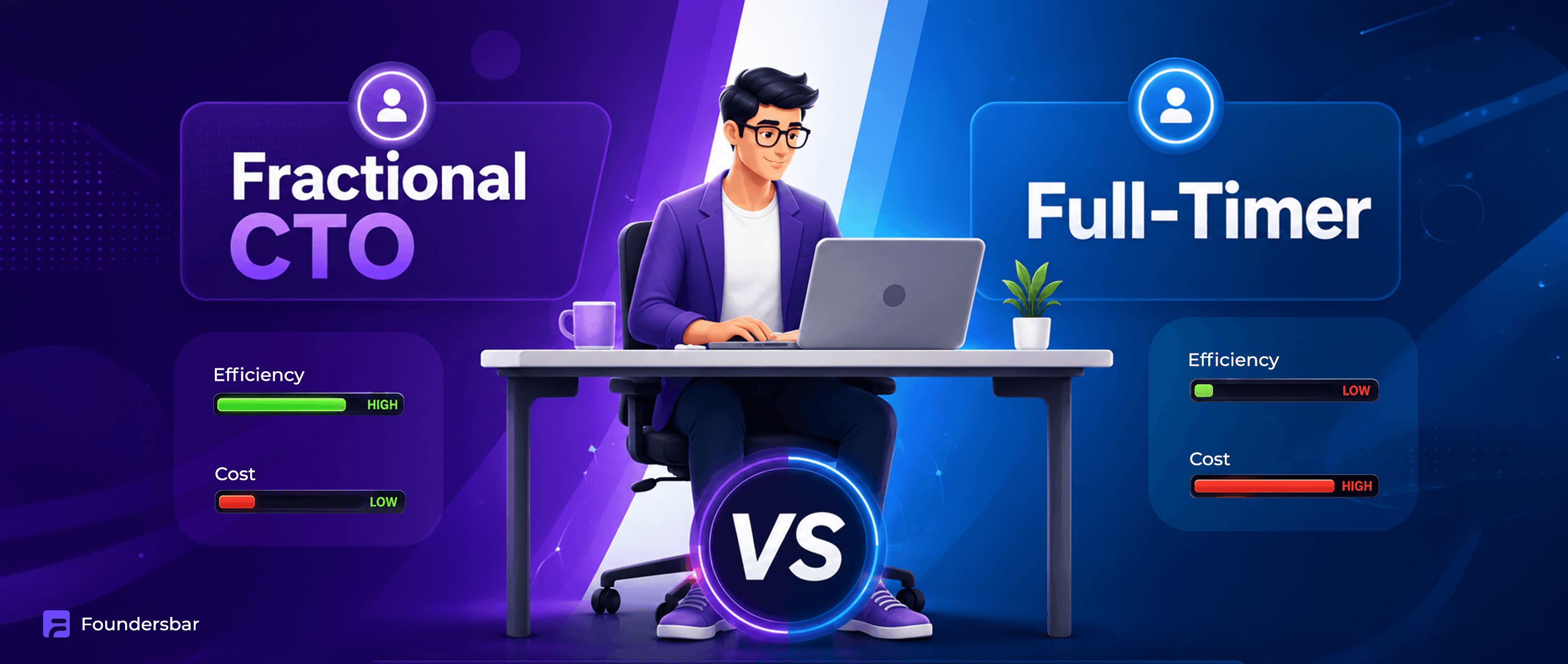
Fractional CTO vs Technical Co-Founder: Which Should Startups Choose
A practical comparison of fractional CTOs and technical co-founders, covering equity, costs, time commitment, responsibilities, risk, and startup-stage fit. Learn how to decide whether your startup needs a technical partner who owns the company or a senior technical leader who can provide expertise without giving up significant equity.

Fractional CTO vs Technical Co-Founder: Which Should Startups Choose
Non-technical founders treat this as one question with one answer. It is not. A technical co-founder is a partner. A fractional CTO is a senior operator you hire for a slice of the week. One takes a large piece of the company and stays. The other takes a retainer and leaves when the function can stand on its own. Confusing those two is how you either give away 20% to the wrong person or try to rent a co-founder and wonder why they will not work weekends for free.
This article compares fractional CTO vs technical co-founder on the only variables that matter: ownership, equity, cost, hours, risk if it goes wrong, and which startup stage each one actually fits. If you are choosing between titles, start with the work on the calendar. Then decide whether you need a partner or a leader.
What Is a Fractional CTO?
A fractional CTO is a part-time Chief Technology Officer. They work roughly 10 to 25 hours a week on a monthly cash retainer, own technical strategy and architecture inside a written scope, run the hiring bar, keep vendors honest, and make the company legible in diligence. They are not a co-owner. They usually work with more than one company.
The model exists because most early teams need executive technical judgment before they can keep a full-time CTO busy, and long before they should hand a stranger 15% to 30% of the cap table. You buy decisions and oversight. You still need engineers or an agency to write the product. For the full job description, see What Does a Fractional CTO Do (and Not Do) for Startups.
What Is a Technical Co-Founder?
A technical co-founder is an owner who builds and leads technology as their company, not as a client. They typically join at idea or pre-seed, take a large equity grant, work full-time, and stay through the ugly years. They write the first version, hire the first engineers, fight with you about product, and live with the consequences on the cap table.
Real co-founder equity for someone joining at the start often lands in the 15% to 30% range, vesting over four years with a one-year cliff. Someone joining after you already have users and a raise is usually an early executive, not a co-founder, even if the deck says otherwise. That distinction matters. Calling an employee a co-founder does not make them one. Giving co-founder equity to someone who will not own the outcome is how companies get stuck with a partner they cannot fire without a legal mess.
Fractional CTO vs Technical Co-Founder - Full Comparison
Read the equity row and the exit-risk row before you romanticize either option.
The honest fractional CTO vs co founder cost comparison is cash now versus equity forever. A year of fractional leadership at $8,000 to $12,000 a month is $96,000 to $144,000. A co-founder at 20% owns a fifth of whatever the company becomes. Both can be cheap. Both can be the most expensive decision you make. It depends on whether you needed a partner or a function.
Pros and Cons of Each Option
Fractional CTO: pros
- Speed. You can have senior coverage in days, not after a six-month courtship.
- Cap table stays clean. No 20% grant to someone you met twice at a meetup.
- Reversible. Bad fit ends with a notice period, not a founder divorce.
- Pattern recognition. They have seen the same stack and hiring mistakes at other companies.
- Forces you to hire builders separately. That is a feature. Leadership and coding seats are different jobs.
Fractional CTO: cons
- They will not live the company. Nights, weekends, and identity stay with you.
- Shared calendar. They are not your 2 a.m. pager by default.
- They do not replace hands. If nobody is writing code, the retainer will not ship an MVP.
- Investors sometimes want a technical name on the founding team. You can explain a fractional seat. You cannot fake a co-founder.
Technical co-founder: pros
- Full-time ownership. The product and the company are theirs too.
- They build and lead. Early on that combination is hard to rent.
- Alignment through equity. Upside and downside sit on the same cap table.
- Fundraising optics. Many investors still prefer a technical founder in the room.
- Continuity. Institutional knowledge does not leave when a contract ends.
Technical co-founder: cons
- Hard to find, easy to mis-hire. Chemistry plus skill plus stamina is rare.
- Equity is expensive if they are average. 20% to a weak partner follows you to exit.
- Ugly to unwind. Vesting helps. It does not make a founder split cheap.
- You still might need a later CTO. Great early builders are not always the person to scale an org at Series A.
- Search time is real. Waiting a year for the perfect partner while the market moves is its own cost.
When Should You Choose a Fractional CTO?
Choose a fractional CTO when you need senior technical leadership now and you do not yet have, or do not want to wait for, a partner who should own a large piece of the company.
This is usually the better move if: you can hire a fractional CTO or an agency and need someone qualified to direct them; you are a non-technical founder who keeps getting pitched by people who want co-founder equity for a three-month build; you already tried the co-founder search and the people who said yes were not people you would want to be stuck with; a raise or a rebuild is coming and the decisions cannot wait; you want to test the product before locking a partner onto the cap table.
A fractional seat is also the right bridge after a technical co-founder leaves. Do not panic-hand 15% to the first senior engineer who will take the title. Stabilize the function first.
When Should You Choose a Technical Co-Founder?
Choose a technical co-founder when the company needs a builder-owner, not a rented executive. The product is the technology. You will be making product and architecture calls every day for years. You want someone who will still be there when the retainer would have ended.
This is the better move if: you are pre-product and the first 12 months are mostly building; you have found a person you already trust under stress, not just on a coffee chat; you are willing to give real equity and real authority; investors in your category treat a missing technical founder as a hard no; you personally do not want to be the only owner carrying the company.
Do not choose a co-founder just because Twitter said non-technical founders cannot raise. Plenty of companies ship with a strong operator founder plus hired technical leadership. Choose a co-founder because you found one worth the equity, not because you are lonely in the stack.
Key Factors to Consider Before Deciding
- How technical is the wedge? A novel systems problem needs an owner in the code. A workflow product on known rails needs judgment and a small team more than a 25% partner.
- Who will write v1? If the answer is "the co-founder," you need a co-founder or you need to budget for builders plus a fractional CTO. There is no third option where leadership types the product into existence.
- Cap table math. 20% forever versus $100,000 this year. Model both against a realistic outcome, not a fantasy exit.
- Time. Can the company wait six months to find a partner? If not, fractional covers the gap while you keep looking.
- Trust under conflict. Co-founders fight about product, money, and pace. If you cannot picture that fight ending well, do not sign the stock grant.
- Fundraising reality in your market. Ask investors you actually want, not Twitter. Some funds require a technical founder. Many care more that the system works and someone senior can defend it.
- Exit path for the seat. Fractional should end in an internal lead or a full-time CTO. A co-founder should still be the right partner at Series A. If you already know they will not be, do not use the title.
Decision Framework
Work these in order. Answer what is true, not what sounds like a founder story.
- Is the immediate gap code? You need builders. A title will not compile.
- Have you already found a person you would give 15% or more, vest on a cliff, and still want in the company after a bad year? If yes, recruit them as a co-founder. If you are imagining that person, you do not have them yet.
- Do you need architecture, hiring, and vendor control in the next 90 days while you keep searching or while you hire a team? That is a fractional CTO.
- Is the product a deep technical bet that only works if an owner lives in the system for years? Bias toward a co-founder. Keep the search standard high. Do not fill the slot with a contractor you rebrand.
- Is the product buildable by a small hired team on known infrastructure, and is your advantage distribution, domain, or workflow? Bias toward fractional plus hired engineers. Keep your equity for people who will still be compounding in year five.
- Are you using "I need a technical co-founder" as a way to avoid learning enough of the product to manage a technical leader? Fix that either way. A co-founder will resent it. A fractional CTO cannot save it.
A clean split many non-technical founders miss: search for a co-founder in parallel if you truly want one, and hire fractional coverage so the company does not stall during the search. Those are not mutually exclusive. Waiting with no technical owner is the expensive third path.
Final Thoughts & Recommendation
Fractional CTO vs technical co-founder is a partnership question first and a staffing question second. If you have found an owner worth a large grant, take the partner. If you have not, do not invent one out of loneliness or investor folklore. Buy the leadership function via a fractional CTO service for startups - hire people to build, and keep the cap table for a person who deserves it.
For most non-technical founders who need to move in the next quarter, the practical sequence is: a fractional CTO plus a small build team now, co-founder later only if the right person appears. That is not a lesser version of a startup. It is how you avoid paying 20% for a three-month contractor with better branding.
Ready to move this quarter? Plug in Foundersbar’s fractional CTO service for startups-senior leadership, clear architecture, and delivery without equity dilution. Learn more and book a scoping call: Foundersbar
Frequently Asked Question
Thinking about building a product or taking it to market?
Thinking about building a product or taking it to market?
Thinking about building a product or taking it to market?
Thinking about building a product or taking it to market?