Startup Market Research: How to Find Real Customers
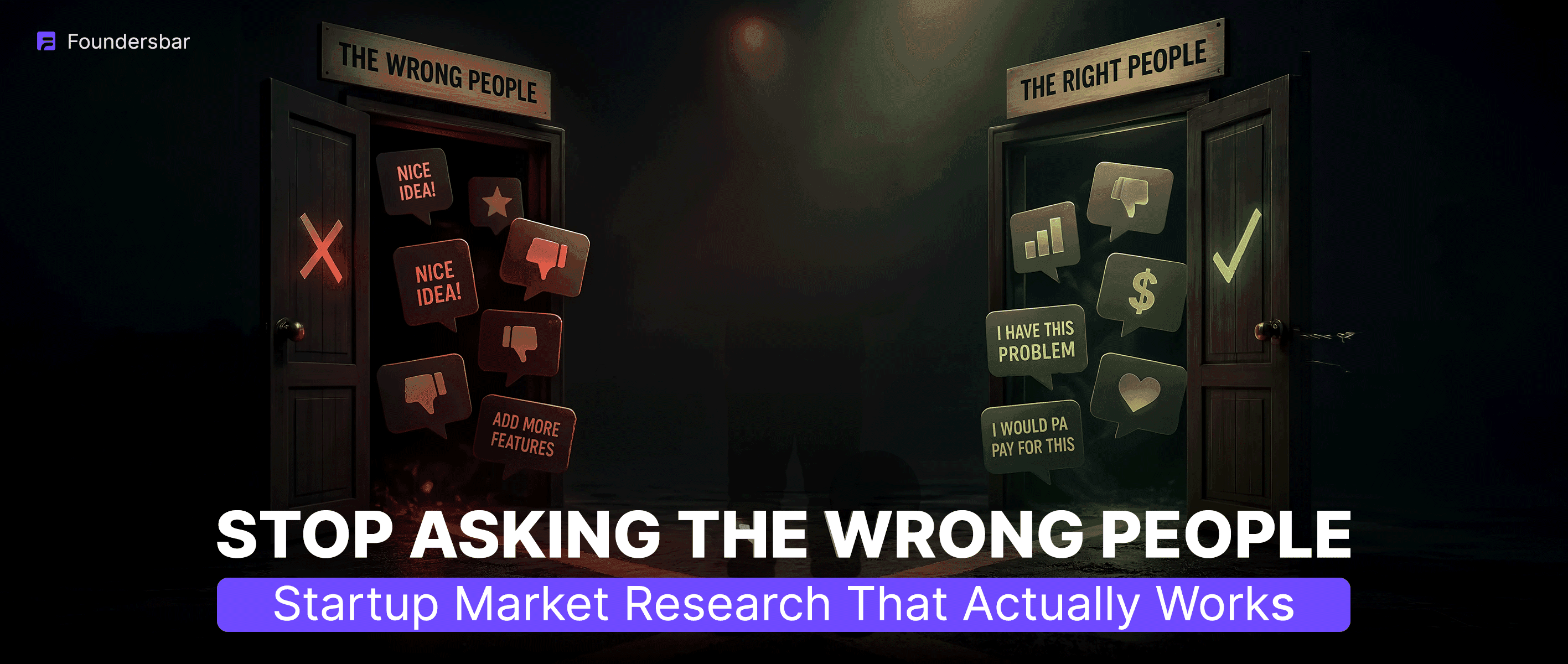
Early-stage founders, especially first-timers, often make a critical mistake during market research: they talk to the wrong people. They ask friends, family, and a few people in the industry for feedback. For example, if you are building a revolutionary POS system, you might interview a couple of restaurant owners. While this feels productive, it is often misleading. The harsh truth is this: Most people who give you feedback have no intention of buying your product. Yet they will happily request flashy features, suggest improvements, and give advice that can send you in the wrong direction. So the big question is: Should you even listen to users who will never buy?
The problem with casual feedback
When you ask someone What do you think of this idea? or What features would you want?, most people respond in one of two ways:
- They try to be nice and say positive things (even if they would not pay for it).
- They treat it like a wish list and ask for every feature under the sun - features they would never actually use.
This is extremely common. Studies and founder experiences show that a large percentage of early interviews produce low-signal feedback from people who have zero buying intent.
According to CB Insights, 42 to 43% of startups fail because there was no market need for what they built. One major reason is that founders built based on feedback from the wrong people [1].
Why this happens so often
First-time founders fall into this trap for several reasons: [6]
- They do not know how to find real potential customers.
- They feel more comfortable talking to people they already know.
- They confuse people giving feedback with people who have a real problem and are willing to pay to solve it.
- They believe more feedback equals a better product (when often the opposite is true).
The result? You end up building features that sound good in theory but have no real demand.
The solution: The mom test framework
The best framework for this exact problem comes from Rob Fitzpatrick book The Mom Test [2].
The core idea is simple: Talk about your customers life and problems, not about your idea. [8]
Even your mom (who loves you and wants to protect your feelings) cannot lie to you if you ask the right questions.
Here are the key rules from The Mom Test:
These questions reveal whether someone actually has a painful problem and is willing to pay to fix it - instead of just being polite or dreaming about features.
How to filter out feature requesters who will never buy
Here are practical ways to separate real potential customers from people who are just giving free advice:
- Pre-screen before the interview - Ask basic qualifying questions like: How often do you face this problem? Have you tried solving it before? What have you already tried? [4]
- Look for skin in the game - Real customers show commitment through their actions and answers: They have already spent money trying to solve the problem. They can clearly describe the cost (in time or money) of the current solution. They express urgency (I need this solved soon). [7]
- Ask the Would you pay today? question - This is one of the most powerful filters. If someone says Yeah, I would pay for that eventually, they are probably not serious. Real buyers say things like I would pay $X right now if it solved Y.
- Ignore feature requests until you have validation - Early on, treat most feature suggestions as noise. Only pay attention to features that come up repeatedly from people who have a real, painful problem and show buying intent. [5]
Better ways to do market research and validation
Instead of random conversations, follow this structured approach:
- Start with problem interviews (not solution interviews). Talk about their current struggles before showing your idea.
- Use the 5 Whys technique to dig deeper into real pain points.
- Look for committed customers - people who are actively searching for a solution right now.
- Run small experiments - landing pages, waitlists, or fake door tests - to measure real interest instead of just opinions. [10]
- Focus on a narrow beachhead market first (a small, specific group) rather than trying to talk to everyone. [9]
Many early-stage founders use professional market validation services to run this process more effectively and avoid common pitfalls.
Professional customer discovery shows that the quality of conversations matters far more than the quantity [3].
When should you actually listen to feedback?
You should listen carefully when:
- The person has the exact problem you are trying to solve.
- They have already tried (and failed) to solve it themselves.
- They show clear signs they would pay for a better solution.
- The same feedback comes from multiple independent sources with real buying intent.
Everything else should be taken with a big grain of salt.
Final thoughts
Early-stage market research is not about collecting as many opinions as possible. It is about finding real signals from people who have a painful problem and are willing to pay to solve it.
Most of the advice and feature requests you will receive in the beginning will come from people who will never buy your product. Listening to them too much is one of the fastest ways to build something nobody wants.
The founders who succeed are the ones who learn to filter ruthlessly - focusing on high-intent customers and asking questions that reveal the truth, not just what people think you want to hear.
This is one of the most important skills in startup market research and customer validation. Master it early, and you dramatically increase your chances of building something people will actually pay for.
Quick Action Checklist for Founders
- Have I talked to at least 15 to 20 people who actually have the problem?
- Am I asking about their current behavior and pain (not pitching my solution)?
- Have I filtered out people who are just being polite or giving random advice?
- Do I have evidence that at least some people would pay for a solution today?
- Am I focusing on a narrow target market first instead of trying to please everyone?
CB Insights. (2024). The Top Reasons Startups Fail. [Link]
Fitzpatrick, R. (2013). The Mom Test: How to Talk to Customers and Learn If Your Business Is a Good Idea When Everyone Is Lying to You. [Link]
First Round Review. (2025). How to Know if Your Idea is the Right One - A Founders Guide for Successful Early Stage Customer Discovery. [Link]
Bridge for Billions. (2019). Customer Discovery: The Dos and Donts of Talking to Your Potential Customers. [Link]
Ant Murphy. (2024). 4 Common Product Discovery Mistakes (and How to Avoid Them). [Link]
Harvard Innovation Labs. (2025). First-Time Founder Mistakes. [Link]
Sprocket. (2025). The Customer Discovery Process: How to Validate Assumptions. [Link]
Looppanel. (2023). The Mom Test for Better Customer Interviews. [Link]
HubSpot. (2025). Startup Idea Validation: A Step-by-Step Guide Before Launch. [Link]
OpenVC. (2025). How to Validate Your Startup Idea - 7 Methods Explained. [Link]
Thinking about building a product or taking it to market?
Thinking about building a product or taking it to market?
Thinking about building a product or taking it to market?
Thinking about building a product or taking it to market?