Why First-Time Founders Overbuild Their MVP
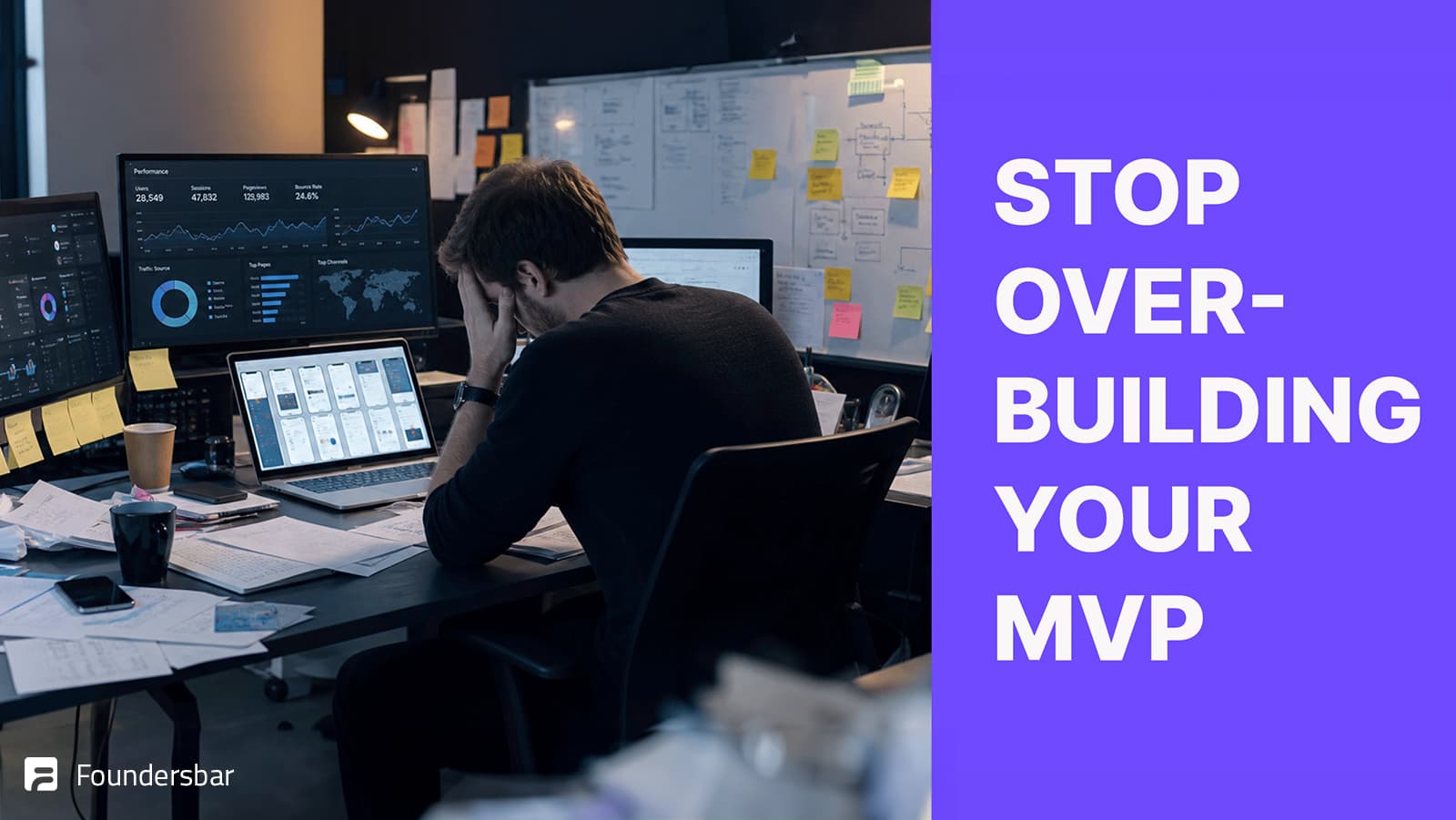
Most first-time founders make the same expensive mistake: they try to build everything into their MVP. They obsess over features, polish every edge case, and spend months (sometimes years) creating a complete product - all before they have even a single real user. What starts as excitement quickly turns into a bloated, expensive, and confusing product that nobody wants. This is one of the biggest silent killers in startup MVP development.
The harsh reality: Most startups fail because they built the wrong thing
According to CB Insights analysis of failed startups, 42 to 43% fail because there was no market need for what they built [1].
Another major study found that 45% of MVP projects suffer from scope creep, leading to a 40 to 60% increase in development timelines and an average 35% budget overrun [2].
The pattern is clear: Founders who try to build a full-featured product from day one almost always lose.
Why first-time founders overbuild their MVP
There are several psychological and practical reasons behind this common mistake:
- Perfectionism - They believe the product must be perfect before launch.
- Fear of missing out - They worry users will reject a simple version.
- Misunderstanding MVP - Many think MVP means Minimum Viable Product instead of Minimum Testable Product.
- Belief in Product-Led Growth - They assume if we build it, users will come naturally.
In reality, most first-time founders spend the majority of their time and money on planning and building extended features while they have zero users. This is the opposite of what they should be doing. [4]
The real cost of building everything
When you try to include every feature and edge case in your MVP, several bad things happen: [7]
A classic example is Instagram. The founders originally built an app called Burbn packed with check-ins, points, and many other features. Users barely used it. After stripping almost everything away and focusing only on photo sharing with filters, they launched Instagram and got 25,000 users in the first 24 hours.[3]
Business is a numbers game: Impact over perfection
Every feature you add costs time and money. The question every founder must ask is: What is the expected return on this feature?
Most features in early MVPs deliver very low or zero return because very few users will ever use them, they do not solve the core problem, and they delay the moment you can start learning from real customers. [6]
Smart founders focus on impact, not perfection. They ask: Does this feature help us validate our core hypothesis? Will it significantly increase user retention or conversion? Can we test this assumption with a much simpler version?
The dangerous myth of build it and they will come
Many first-time founders believe in Product-Led Growth (PLG) as their main strategy. They think if the product is good enough, users will naturally find it and tell others.
This is a dangerous myth for most startups. Product-Led Growth works well for certain types of products (like Slack or Notion), but it rarely works in the very early stages. Most successful startups combine product with active customer acquisition from day one.
Focusing only on building while ignoring distribution is one of the fastest ways to run out of money with nothing to show for it.
What you should do instead
Here is the smarter approach used by successful founders:
- Define one clear hypothesis - What is the single most important assumption you need to test?
- Build the smallest possible version - Usually in 8 to 12 weeks maximum.
- Launch to real users quickly - Even if it is ugly or incomplete.
- Talk to customers constantly - Spend more time on customer interviews than coding.
- Measure what matters - Focus on activation, retention, and willingness to pay - not feature count.
- Iterate based on real data - Only add features that users actually ask for or that move key metrics.
Professional mvp development services for startups often recommend this exact lean approach. The any decent agency offering mvp development services would help founders ruthlessly cut scope so they can launch fast and learn faster.
Rare exceptions: When you can build more
There are very rare cases (like early ChatGPT or the original iPhone) where building something more complete makes sense. But even in these cases, the founders usually had deep domain expertise, tested with a small group of users first, and still launched with a focused core experience.
For 99% of startups, this is not the right path.
Final thoughts
Building everything into your MVP feels productive. It feels like you are making progress. But in most cases, it is the fastest way to waste time, money, and opportunity.
The real goal of startup MVP development is not to build a complete product. The real goal is to learn as fast and cheaply as possible whether your idea has a chance of working.
Stop trying to build the perfect product. Start building the smallest thing that lets you talk to real users and get honest feedback.
That is how great companies are actually built.
Quick Checklist for Founders
- Have I defined the single most important hypothesis to test?
- Am I building only what is needed to test that hypothesis?
- Have I spoken to at least 20 to 30 potential users before writing code?
- Am I spending more time on customer acquisition than on new features?
- Can I launch this MVP in the next 6 to 12 weeks?
CB Insights. (2024). The Top Reasons Startups Fail. [Link]
Emphasoft. (2025). MVP Myths: Why Founders Blow Their Budget. [Link]
ENEB. (2026). Strategic Pivoting: How Burbn Turned into Instagram. [Link]
CRV. (2026). MVP Stage of Startup: What Investors Expect Before Series A. [Link]
Erlang Solutions. (2025). Common MVP Mistakes: How to Build Smart Without Overbuilding. [Link]
Thoughtbot. (2025). Common Mistakes Founders Make When Building an MVP. [Link]
Imaginovation. (2025). How to Prevent and Manage Scope Creep in MVP. [Link]
American Chase. (2025). 15 Critical MVP Development Mistakes to Avoid in 2025. [Link]
Avoma. (2025). 6 Myths About Product-Led Growth That SaaS Founders Need to Be Aware Of. [Link]
Horizon Labs. (2025). Mistakes to Avoid When Building Your First Product. [Link]
Thinking about building a product or taking it to market?
Thinking about building a product or taking it to market?
Thinking about building a product or taking it to market?
Thinking about building a product or taking it to market?