Waterfall vs Agile: Best Approach for Startup MVP Development
If you're searching for startup MVP development, MVP development services, or the right MVP development process, you've likely seen endless advice pushing Agile as the only way."Move fast, iterate, fail fast." But here's the uncomfortable truth backed by founder experiences and project data: for the majority of early-stage startups - especially part-time founders with strong vision but fuzzy requirements - a structured, blueprint-first approach (heavily inspired by Waterfall's upfront definition) delivers better results than jumping straight into Agile sprints. This is not about rejecting Agile entirely. It is about recognizing that true Agile requires discipline most pre-launch startups simply don't have yet.
Reality : Most startup MVPs start vague
According to CB Insights' 2026 analysis of hundreds of startup post-mortems, 42% of startups fail primarily because there is no market need for what they built [1]. Another major culprit is running out of capital - often a symptom of burning money on the wrong features.
Part-time founders (still holding a job while building) are especially vulnerable. They have a compelling vision and a rough idea of the problem, but limited time to translate that into precise features, user flows, technical architecture, and success metrics. The result? They approach custom software development or startup software development companies with a loose brief.
This lack of clarity is expensive when pursuing startup mvp development. Agencies and freelancers - not out of malice, but because of how contracts work - often end up in open-ended arrangements. Every clarification becomes billable time. Scope creeps. Decisions get deferred. What should have been a focused 3-month MVP turns into 6-9 months and $80k-$150k with little to show.
Agile's promise vs. Startup reality
Agile (and its variants like Scrum or Kanban) shines when requirements are fluid and rapid feedback is possible. Standish Group's CHAOS reports consistently show Agile projects succeeding at roughly 3x the rate of traditional Waterfall projects overall [2].
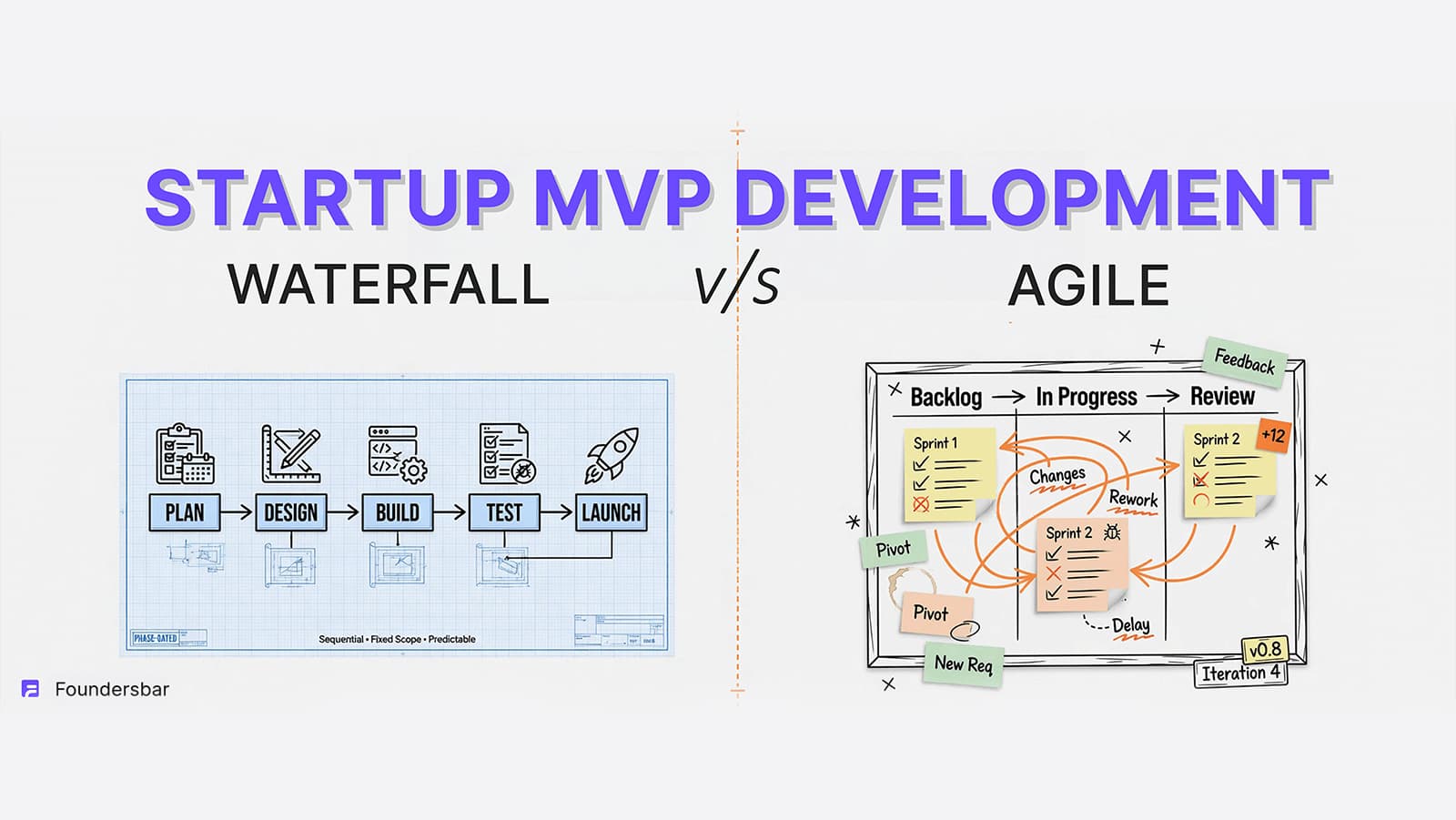
But here's the critical caveat for startup MVP development: most early teams don't practice disciplined Agile. They practice "Agile theater" - endless sprints without clear acceptance criteria, backlog grooming that never happens, and "we'll decide later" becoming the default.
When you defer hard decisions (What is the absolute minimum set of features? How do users actually flow through the app? What tech stack supports our scale goals?), complexity explodes. PMI research shows scope creep affects 48-70% of projects [10], driving massive overruns. In startups with limited runway, this is fatal.
Waterfall, by contrast, forces a linear, disciplined sequence: define, design, build, test, deploy. For the initial MVP - where the goal is often market validation rather than constant pivoting - this upfront rigor is a feature, not a bug.
Why Waterfall-Style thinking wins for most early MVPs
1. It forces founders to think
You cannot hand a developer "an app like Uber but for X" and expect magic. Waterfall demands you answer: Who is the user? What is their core pain? What is the smallest thing that proves value? What are the non-negotiables vs. nice-to-haves?
2. It creates a single source of truth
Every decision is documented with why it was made. When the inevitable "Can we add this feature?" conversation happens (and it will), you have a baseline to evaluate trade-offs against.
3. It protects against agency/freelancer incentives
With a clear blueprint, you move from "time and materials, open scope" to fixed-scope or milestone-based contracts. Clarity reduces billable ambiguity.
4. It prevents later-stage complexity explosions
Agile is excellent after you have a solid foundation. Trying to be agile with undefined requirements is like building a house while the architect is still drawing plans on napkins.
The solution: Start with an MVP Product Blueprint
This is exactly why services like the Startup Product Blueprint from Foundersbar exist. Think of it as architectural drawings before you pour concrete.
A proper blueprint typically includes:
- Product Vision Breakdown - Core goal, target users, value proposition
- Detailed Feature Requirements - Use cases, user flows, functional specs
- UX Flows and System Design - End-to-end architecture and recommended tech stack
- Development Timeline and Cost Estimation - Phased roadmap with realistic budgets
- Interactive Prototype - Clickable Figma version you can test and share
The process usually takes 1-3 weeks and gives you something concrete to hand to any MVP development services provider or in-house team.
Founders who invest in this upfront phase consistently report:
- Faster time-to-first working version
- Significantly lower total cost
- Much clearer conversations with developers
- Higher confidence when raising capital (investors love seeing a validated blueprint plus prototype)
You can explore the full approach here: Startup Product Blueprint and the accompanying research article here: Startup Product Blueprint: First Step Before Building MVP.
When Agile does make sense
Once you have a solid blueprint and have launched your initial MVP, switch to Agile for iteration. Post-launch feedback loops, A/B testing, and rapid feature addition are where Agile's strengths shine. Many successful startups use a hybrid model: Waterfall-style planning for major releases or new modules, Agile execution within those boundaries [3][5][7].
Recent 2025-2026 analyses confirm that hybrid approaches often outperform pure methodologies on complex projects [6][8][9].
Practical recommendation for founders
If you're a part-time or first-time founder still refining your vision:
- Do not hire developers or sign with an agency until you have a clear product blueprint.
- Invest 2-4 weeks in proper discovery and documentation.
- Use the blueprint to run competitive MVP development services quotes on a fixed or milestone basis.
- After launch, adopt Agile practices for continuous improvement.
This approach doesn't slow you down when doing startup mvp development - it prevents the expensive detours that kill most early startups.
Final thought
The best methodology isn't the one that sounds the most modern. It's the one that matches your current stage of clarity.
For most founders still in the "idea with vision but not fully defined" phase, starting with structured planning (Waterfall thinking plus a professional product blueprint) is the fastest, cheapest, and least painful path to a successful startup MVP development.
Build with clarity first. Iterate with agility later.
CB Insights (2026). Why Startups Fail: Top 9 Reasons. [Link]
Mersino, A. (2020). Why Agile is Better than Waterfall (Based on Standish Group Chaos Study). Medium. [Link]
A Purple (2026). Agile vs Waterfall for Startups in 2026: Which Actually Works. [Link]
Frontetica (2024). How to Choose the Right Methodology for MVP Development. [Link]
monday.com (2025). Agile Vs. Waterfall Vs. Scrum: The Complete Guide For 2026. [Link]
International Journal of Future Management Research (2025). A Comparison Between Agile and Waterfall Approaches. [Link]
Mtechzilla (2026). How to Choose the Right App Development Model in 2026. [Link]
Scalevista (2025). Agile Development Methodology for MVP Success. [Link]
Iotric (2025). Agile vs Waterfall: Which is Best for Your MVP Development? [Link]
monday.com (2025). 110+ Project Management Statistics and Trends for 2026 (PMI scope creep data). [Link]
Thinking about building a product or taking it to market?
Thinking about building a product or taking it to market?
Thinking about building a product or taking it to market?
Thinking about building a product or taking it to market?