Why AI isn't making complex software quotes 60% cheaper
The 40-20-40 Rule in the Age of AI
The hype meets the spreadsheet
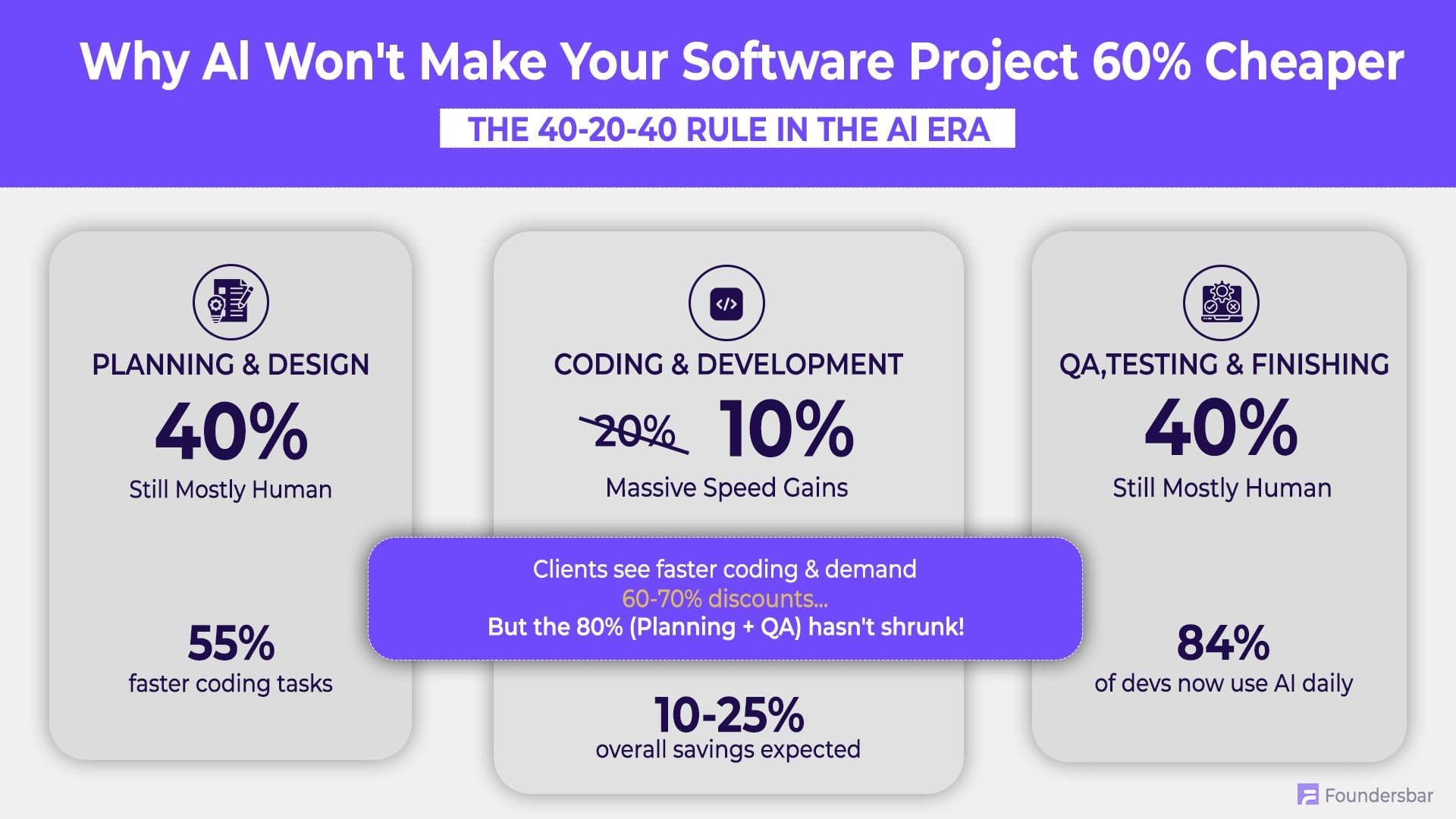
If you've been in software development for more than a few years, you know the old rule of thumb: roughly 40% of a project's effort goes into planning and design, 20% into actual coding, and 40% into testing, quality assurance, integration, user acceptance testing (UAT), and deployment [1]. It's not a law of physics, but it's been remarkably consistent across waterfall, agile, and hybrid projects alike.
Then came generative AI coding assistants, GitHub Copilot, Cursor, Claude Code, and their like, in controlled or well-scoped tasks, AI coding assistants have shown large gains - GitHub/Microsoft research found a Copilot group completing one task about 55% faster. But the gain is task-dependent, and other studies show weaker or even negative results on complex, familiar codebases [2]. Agency clients noticed. And in boardrooms across the world, a dangerous assumption took hold: "If AI writes the code, why are we still paying full price?"
The result? In early 2026, a growing chorus of clients is demanding 50-70% reductions in development quotes. Some are getting 20-30% concessions. Most are getting polite pushback. The reality, as always, lies in the numbers, and in the parts of the 40-20-40 equation that AI hasn't touched yet.
The enduring 40-20-40 rule
The 40-20-40 heuristic has been taught in software engineering curricula for decades. It breaks down like this:
- 40% Planning & Design: Requirements gathering, stakeholder interviews, architecture decisions, wireframing, technical specification, risk analysis. This is where the hardest, and most expensive, work happens. Get it wrong, and no amount of fast coding saves you.
- 20% Development (Coding): The actual writing of code. This is the part that feels most "productive" but has historically been the smallest slice of the pie. It's also the most automatable.
- 40% Quality & Finishing: Unit/integration testing, code review, security audits, performance tuning, UAT, bug fixing, documentation, deployment pipelines, monitoring setup, and production stabilisation. This is where projects live or die.
The rule's power isn't in its precision, it's in reminding teams that coding is the easy part. The expensive parts are deciding what to build and ensuring it actually works in the real world.
AI's assault on the 20%: Real gains, real limits
There's no denying the productivity boost. Controlled studies in 2025-2026 show developers using AI coding assistants complete programming tasks up to 55% faster. Boilerplate, repetitive CRUD operations, and well-scoped features that once took days now take hours. GitHub Copilot crossed 20 million users by mid-2025, and Stack Overflow's 2025 survey found that 84% of respondents were using or planning to use AI tools in development, while 51% of professional developers reporting daily usage [3].
But here's the catch that clients often miss even when coding is 2-3x faster, the surrounding work doesn't disappear, it shifts. Developers are also reporting a verification burden. Stack Overflow's 2025 survey found that 45% cited debugging AI-generated code as more time-consuming, and Sonar's 2026 survey reported that 96% of developers do not fully trust AI-generated code to be functionally correct, than they did writing from scratch [4]. The "last mile" of integration, edge-case handling, and production hardening remains stubbornly human.
In short: AI has compressed the 20% into something closer to 8-12% for many projects. That's a massive win. But it has not removed the accountability-heavy parts of the work: deciding what to build, integrating it into a real system, validating quality, handling edge cases, and supporting it in production [5].
The client revolt: "Why is my quote still so high?"
Walk into any software agency Slack channel in 2026 and you'll see the same story: clients citing AI tools and demanding massive price cuts. Some founders are blunt: "Claude just built my MVP in a weekend, why should I pay you $80k?"
The data backs up the pressure. GoodFirms' 2026 software development cost survey reported that 90.6% of surveyed development companies had adopted AI across planning, coding, testing, or documentation, and that 61% expected AI to reduce project budgets by 10-25% [7].Some buyers are using AI as negotiation leverage, and many agencies are responding with either modest discounts, faster delivery commitments, or reduced-scope packages. The stronger question is not just 'how much cheaper?' but 'what process or risk is being removed?' [6] A few aggressive ones push for 50-70% and occasionally get it from desperate agencies.
But here's what the same agencies quietly report: when they cave to 60% cuts, quality suffers. Scope gets trimmed, QA gets rushed, and six months later the client is back asking for "a few fixes" that cost more than the original discount. The 40-20-40 rule doesn't bend just because the middle 20% got smaller.
The 80% AI hasn't replaced yet
This is the uncomfortable truth the hype cycle ignores. Planning and design still require deep domain expertise, stakeholder management, and trade-off decisions that current AI models handle poorly. Requirements are rarely crisp; they're messy, political, and evolve. AI can draft a spec, but it can't negotiate with the VP of Sales who just changed the priority list.
Quality assurance is even more resistant. AI can generate unit tests, but real-world QA involves understanding user workflows, simulating production load, catching security vulnerabilities that only appear at scale, and navigating the endless "it works on my machine" conversations. The rise of AI-generated code has actually increased the importance of rigorous review, one 2026 analysis called it the "2026 Quality Tax," with teams spending more time debugging AI output than they saved in writing it.
Until we have reliable agentic systems that can handle end-to-end planning, architecture, testing, and deployment with minimal human oversight (still not reliable enough for most complex production projects without senior human oversight), [8] the 80% remains the 80%.
What the numbers actually show in 2026
Let's cut through the noise with real 2026 data:
- Productivity gains: AI can materially speed up scoped coding tasks, with controlled studies showing gains as high as 55% [9]. But overall delivery gains are usually lower because code review, testing, integration, security, and deployment still remain.
- Expected budget impact: 61% of companies anticipate 10-25% project cost reductions from AI, not 60%.
- Client discount reality: 20-30% is the most common concession agencies report making. 50-70% demands exist but are rarely fully granted.
- Hidden costs rising: Code review time has increased; some teams report spending more hours reviewing AI output than writing code from scratch.
How smart agencies are responding
The winners in 2026 aren't racing to the bottom on price. They're doing three things differently:
- Value-based pricing over time-and-materials. Instead of quoting "40 hours of coding," they're quoting "delivered feature with guaranteed QA pass and 90-day support." Clients pay for outcomes, not hours, and AI lets agencies deliver more outcomes in the same (or slightly less) calendar time.
- Transparent AI disclosure + education. Forward-thinking agencies show clients exactly where AI accelerates work and where it doesn't. They frame AI as a quality multiplier, not just a cost cutter: "We'll deliver 30% more features in the same budget because our team uses AI, but the architecture and QA still require senior humans."
- Re-scoping instead of discounting. When a client pushes for a 50% cut, smart agencies respond with: "We can hit your budget, here's what that looks like with reduced scope, or we can keep scope and use AI to deliver it faster." Most clients choose faster delivery over smaller scope.
Advice for clients: Getting real value from AI-accelerated development
If you're a client negotiating in 2026, here's how to think about it:
- Ask for AI transparency, not just discounts. A good agency should explain exactly how they're using AI and where the remaining effort lies. If they can't, that's a red flag.
- Focus on outcomes, not hours. The real question isn't "How much cheaper can you make this?" but "What can we ship in 8 weeks with AI-augmented delivery that we couldn't before?"
- Budget for the parts AI does not make accountable by itself. The agencies that deliver the best results are investing their AI savings into better planning, more thorough QA, and faster iteration cycles, not just lower rates. That's where the real ROI lives.
- Beware the 60% quote. If an agency offers to cut 60% off their normal rate because of AI, ask what they're cutting from the process. The answer usually reveals where corners are being cut.
For simple, well-defined, low-risk projects, AI should reduce cost meaningfully. Landing pages, CRUD dashboards, prototypes, internal tools, and clone-style MVPs can often be built faster than before. The argument here is narrower: complex production software does not become 60% cheaper simply because code generation got faster [10].
This also does not mean agencies should keep old pricing models untouched. Clients should expect AI-driven benefits: faster delivery, better documentation, more test coverage, clearer prototypes, or reduced scope of cost [11]. What they should not expect is a complex build to become dramatically cheaper without removing process, quality, or risk coverage.
The path forward
AI coding tools are genuinely transformative. They've compressed the 20% development slice and given agencies new leverage to deliver more value in less calendar time. But they haven't rewritten the fundamental economics of software projects, at least not yet.
The clients who win in 2026 will be the ones who understand the 40-20-40 rule and negotiate accordingly. The agencies who win will be the ones who use AI to raise quality and scope, not just lower prices. And the projects that succeed will still be the ones where the hardest work, deciding what to build and ensuring it works, gets the attention it deserves.
AI has made the coding slice much more efficient. But software pricing still follows the larger economics of product clarity, engineering judgment, quality assurance, integration, and production responsibility. The rest of the equation? That's still where the real engineering, and the real value, happens.
Reuters coverage of METR 2025 study: https://www.reuters.com/business/ai-slows-down-some-experienced-software-developers-study-finds-2025-07-10/
METR 2025 study: experienced open-source developers took longer with AI on familiar codebases: https://metr.org/blog/2025-07-10-early-2025-ai-experienced-os-dev-study/
Stack Overflow Developer Survey 2025: AI tool usage, daily use, trust, and debugging frustrations: https://survey.stackoverflow.co/2025/ai
Sonar 2026 State of Code press release: verification gap and trust in AI-generated code: https://www.sonarsource.com/company/press-releases/sonar-data-reveals-critical-verification-gap-in-ai-coding/
DORA 2025 State of AI-assisted Software Development: AI as an amplifier and systems problem: https://dora.dev/dora-report-2025/
GoodFirms 2026 custom software development cost survey: https://www.goodfirms.co/resources/custom-software-development-cost-survey
GlobeNewswire release summarizing GoodFirms 2026 survey numbers: https://www.globenewswire.com/news-release/2026/03/17/3257317/0/en/goodfirms-survey-91-of-software-companies-use-ai-to-cut-development-costs-in-2026.html
Google Cloud DORA 2025 report page: https://cloud.google.com/resources/content/2025-dora-ai-assisted-software-development-report
Microsoft Research paper version: The Impact of AI on Developer Productivity: https://www.microsoft.com/en-us/research/publication/the-impact-of-ai-on-developer-productivity-evidence-from-github-copilot/
GitHub / Microsoft research: Copilot group completed a programming task about 55% faster: https://github.blog/news-insights/research/research-quantifying-github-copilots-impact-on-developer-productivity-and-happiness/
Sonar 2026 State of Code press release: verification gap and trust in AI-generated code: https://www.sonarsource.com/company/press-releases/sonar-data-reveals-critical-verification-gap-in-ai-coding/
Thinking about building a product or taking it to market?
Thinking about building a product or taking it to market?
Thinking about building a product or taking it to market?
Thinking about building a product or taking it to market?