How SF Founders Choose a Tech Partner for MVP and GTM
A practical guide for San Francisco founders choosing a tech partner for MVP development and go-to-market execution. Learn how to evaluate partners, compare fixed-cost development with hiring, protect IP and ownership, structure an effective MVP-to-GTM engagement, identify red flags, and choose a technical partner that fits the speed, budget, and execution demands of an early-stage startup.
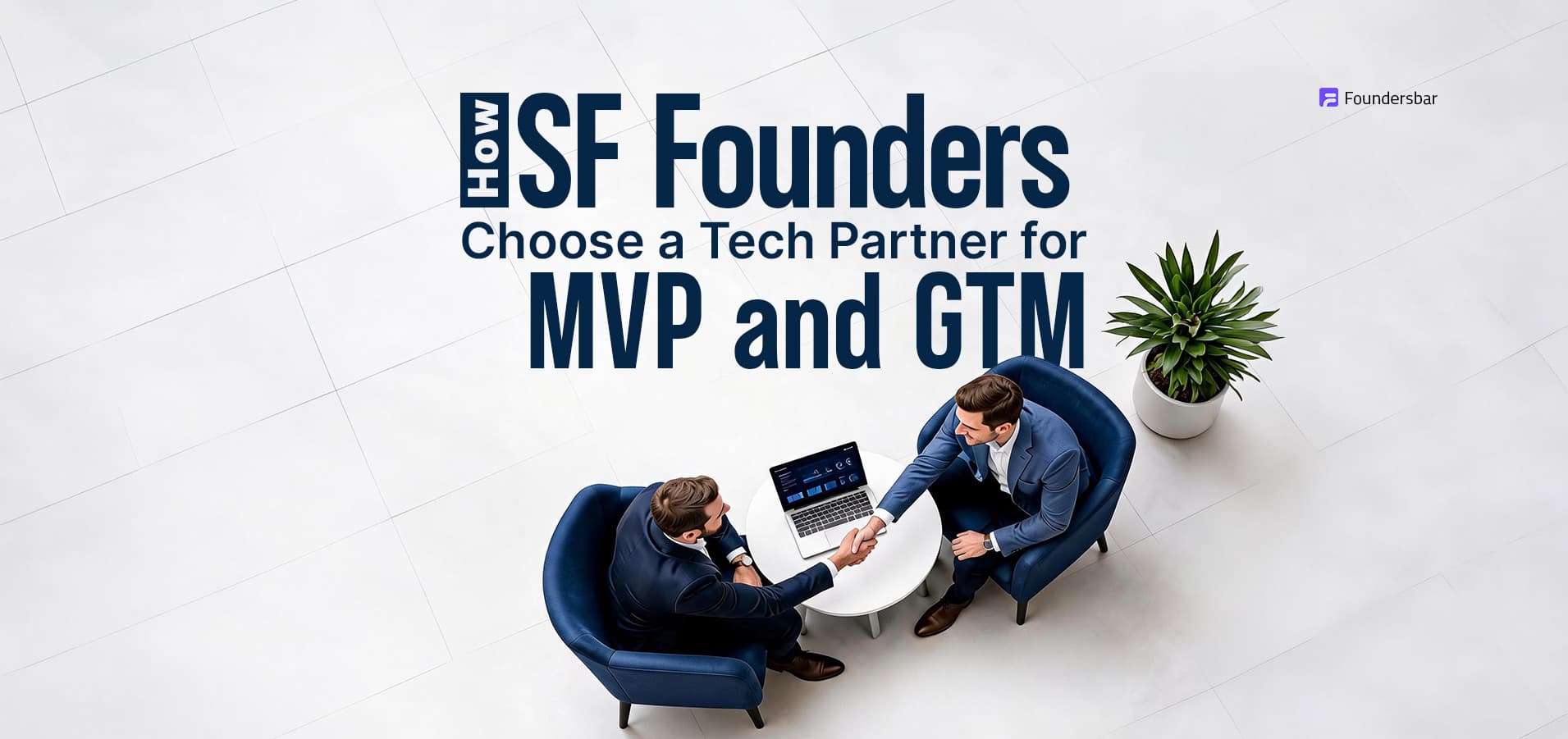
How SF Founders Choose a Tech Partner for MVP and GTM
San Francisco founders should pick a tech partner the same way they pick a first engineer: scoped work, owned IP, a committed timeline, and a team that understands seed constraints. The wrong partner is an agency that bills hours, hides the repo, and treats GTM as a brochure. The right partner is a substitute for a bench you cannot yet hire; not a substitute for knowing what the product is.
This page is the partner spoke inside the San Francisco startup ecosystem hub. Use it before you sign a statement of work you cannot unwind.
Why do San Francisco founders use a tech partner at all?
Because a local engineering org is often the wrong first spend.
A fully loaded SF mid-to-senior engineer is a $215,000-$280,000 year. Two of them plus a private desk and you have spent a seed check before a buyer has used the product. Buyers in this city will compare whatever you ship to companies that already raised nine figures. Speed matters. An unscoped build does not.
A partner makes sense when:
- There is a wedge, but no technical co-founder who can ship full-time.
- There is a technical founder who should be in customer meetings, not writing the first 80% of the backlog.
- You need a fixed-scope MVP and a GTM stack, not a six-person team to manage.
- You want architecture judgment without a full-time CTO.
It does not make sense when the founder cannot say who pays. A partner cannot invent the company. If the idea is still a vibe, stay on the cost of starting a company in San Francisco page and write the sentence first.
What should a tech partner actually do for an SF startup?
Three jobs. Not “digital transformation.”
- Blueprint. Requirements, user journeys, stack, timeline, cost. A prototype before a six-month build.
- Build. A scoped MVP with a committed date and a warranty on what shipped.
- GTM tech. Instrumentation, validation loops, and the marketing stack around the product, not a brand film.
If a shop only wants to staff a squad and start billing, they are a body shop. SF investors will ask who owns the repo, who can change the architecture, and why the burn looks like a services company. Those answers need to be boring.
The build path sits on MVP development for San Francisco startups. The distribution path sits on go-to-market strategy for SF startups. The judgment path sits on fractional CTO services for early-stage SF founders.
How do you evaluate a tech partner in San Francisco?
Meet the builders. If you only meet sales, you are buying a pitch.
San Francisco adds one more test: comparables. Your product will sit next to teams in SoMa who shipped in 90 days. A nine-month “discovery phase” is how you miss the window.
Fixed-cost vs. hire vs. mix: which path fits which stage?
Hiring locally is a separate decision. Comp and time-to-hire live on hiring engineers in San Francisco. Do not open a senior req to avoid writing a scope. That hire will ask for the scope anyway.
What does a good MVP-and-GTM engagement look like?
A sequence, not a swarm.
- Wedge on paper. Who pays, why they switch, what “works” means in 90 days.
- Blueprint and prototype. Journeys, stack, cost, what is out of scope. See it before you fund a build.
- Fixed-cost MVP. Dedicated team, committed timeline, warranty on what shipped.
- Design partners. Ten to twenty conversations with buyers who can say no. In SF, many of those people are a Muni ride away.
- GTM tech. Analytics, onboarding, a validation loop, one channel that is allowed to work before you add four more.
- Handoff. Repo, infra, documentation, and a path to either hire or keep a thin advisory layer.
If step 1 is missing, stop. San Francisco will not save a product that cannot name a customer. The city-level sequence is on how to start a startup in San Francisco.
What red flags should kill the conversation?
- They will not put IP assignment in the contract up front.
- Scope is “agile” with no definition of done and no change-order rule.
- They want to rebuild the stack you already have because it is not their favourite framework.
- GTM means a logo pack and a launch tweet.
- The team that sells is not the team that builds.
- They cannot tell you what they will not do.
- They treat Foundersbar-class constraints, including seed budget, founder-owned IP, dated delivery , as a problem instead of the job.
Also kill it if you cannot answer: what ships, who reviews it, and what happens if the first ten users do not care. A partner cannot carry a founder who will not decide.
How does this connect to Foundersbar?
Foundersbar is a U.S. tech and marketing hub for eligible startups moving from idea to build to GTM. The pieces that map to SF reality are a blueprint and prototype before code, a fixed-cost MVP with a committed timeline, marketing tech for validation, and a fractional CTO when the company is too small for a full-time chief and too risky to go without one. IP and the stack stay with the founder. That is the point in a city where talent is expensive and investors will ask who owns the repo.
Use this page as the filter. Use the hub as the city map. Do not turn the partner decision into a second fundraising process.
If you are choosing between a San Francisco hire and a scoped partner, writing the first MVP definition, or trying to put GTM tech around a product that just shipped, start with the relevant spoke above or move directly to execution planning. The city rewards a hard scope, founder-owned IP, and a date. It punishes hour-billing disguised as product. For founders who need a development-ready blueprint, a fixed-cost MVP, validation systems, or fractional technical guidance, partners built for startups rather than enterprise process close the gap between idea and traction.
San Francisco will compare your product to companies that already have capital and density on their side. Use the San Francisco startup ecosystem hub as the map, then use this page to pick a build path that survives that comparison. Check eligibility and next steps at foundersbar.com.
Frequently Asked Questions
Thinking about building a product or taking it to market?
Thinking about building a product or taking it to market?
Thinking about building a product or taking it to market?
Thinking about building a product or taking it to market?