San Francisco Startup Ecosystem 2026: Founder's City Guide
A comprehensive guide to the San Francisco startup ecosystem in 2026, covering leading industries, venture capital, talent, accelerators, startup resources, costs, challenges, and growth opportunities. Learn how founders can leverage San Francisco’s dense technology and investment network while building efficiently and managing startup costs.
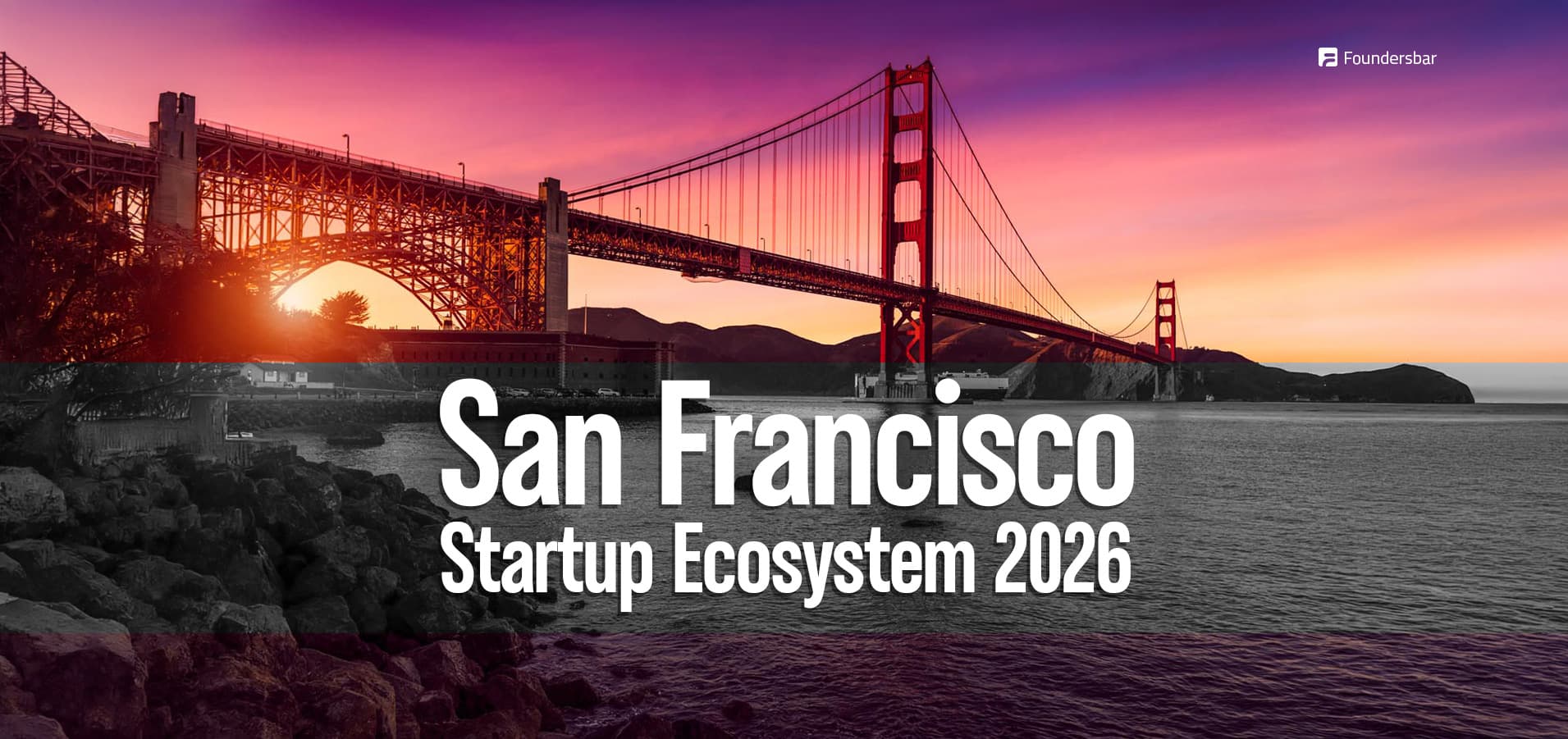
San Francisco Startup Ecosystem 2026: The Founder’s City Guide
San Francisco is still the highest-density place on Earth to raise venture capital, hire AI and software talent, and sit within walking distance of the companies that set the product bar. It is also one of the most expensive U.S. cities to live and hire in. If you need speed, density, and capital, you come here. If you need cheap burn, you do not.
What is San Francisco known for as a startup city?
San Francisco is the world’s unicorn capital and the commercial front door of Silicon Valley. In 2026 it holds the global lead in generative AI private-market value, venture dollars, and founder density. The specialty is not “tech” in the abstract. It is company formation at the frontier: foundation models, applied AI, developer tools, fintech rails, climate software, and life science at the Mission Bay edge.
The city is small, about 47 square miles, packed against the Bay. That compactness is the product. You can walk from a seed office in SoMa to a Series B in South Beach to an AI lab lease in Mission Bay in one afternoon. Stanford and Berkeley are a short train ride. Sand Hill capital sits one peninsula south.
Do not confuse the city with the metro. “San Francisco” in press releases often means the Bay Area. The city is the density node. The peninsula and East Bay are overflow. Treat SF like cheaper Austin and you blow the burn. Treat it as a market you can tap from another time zone and you miss the network. When a founder needs a U.S. build partner instead of a local hiring sprint, teams such as Foundersbar sit in that gap between idea and a shippable MVP.
Why do founders still choose San Francisco over other U.S. cities?
Founders still choose San Francisco because capital, talent, and customers concentrate here faster than anywhere else in the United States. New York has finance and media. Austin and Miami have cost and lifestyle. Boston has deep tech and biotech. SF has the compounding loop: more AI companies hire more AI people, who start more AI companies, who raise from funds that already live here.
- Capital gravity. The Bay Area took about 45% of all U.S. seed dollars in 2025. San Francisco alone closed a record 1,404 seed deals that year, more than double New York.
- Unicorn density. Hurun’s 2026 index named San Francisco the world’s unicorn capital with 222 unicorns. PitchBook has the Bay Area holding eight of the ten most valuable venture-backed companies, led by names such as OpenAI, Anthropic, and Databricks.
- AI supercluster. Analysis in 2026 put roughly 91% of generative-AI unicorn market cap inside a one-hour radius of the Bay Area. That is not a talking point. It is where the weight of the market sits.
- Talent density. San Francisco leads U.S. cities with more than 22% of its workforce in tech. You can hire a specialist in a week that other cities cannot source in a quarter.
- Buyer proximity. Enterprise design partners, research labs, and platform companies are local. A first customer meeting is a Muni ride, not a cross-country flight.
The trade-off is price and noise. Comp and housing sit at the top of U.S. bands. Everyone here is also fundraising. If you do not need this density in the next 18 months, the city burns cash you cannot get back. If you do, staying away is the more expensive decision. Some pre-seed teams keep a light SF presence and use a remote product partner for the first build so local dollars go to distribution, not a six-person bench they cannot yet manage.
What is San Francisco’s real specialty in 2026?
San Francisco’s specialty in 2026 is generative AI and the software layer around it. Everything else in the city now orbits that fact: office demand in SoMa and Mission Bay, seed-check size, engineer comp, and which accelerators fill cohorts.
Other categories are not dead. Fintech still sits on the city’s banks and payments talent. Climate software still raises because the buyers and funds are local. Biotech still clusters in Mission Bay next to UCSF. Crypto never fully left. Pure consumer is thinner than 2014 unless the product has a real distribution wedge.
How does the San Francisco startup ecosystem actually work?
The ecosystem is a stacked market: universities feed talent, accelerators compress the network, venture firms price risk, big tech recycles operators, and neighbourhoods turn that into daily collisions. You do not join it. You pick a layer and show up often enough that people remember the company name.
The stack, in order
- Talent: Stanford, Berkeley, and operators leaving Google, Meta, OpenAI, Anthropic, Salesforce, and Stripe.
- Formation: Y Combinator’s gravity plus SF programs, studios, and founder houses.
- Capital: City and Sand Hill seed funds, multi-stage firms on mega-rounds, and a long angel tail.
- Customers: Other startups, Fortune 500 outposts, and the labs. First ten design partners can all be local.
- Services: Startup lawyers, SAFE-fluent banks, and build partners for teams that should not hire a full eng org at pre-seed.
Public databases tracked 5,800-plus funded companies in San Francisco proper in 2026. Deal counts can fall while dollars rise, reflecting the AI mega-round effect. Seed is still busy. Later stages are barrelled: AI raises, everyone else shows revenue.
Where should a startup sit inside San Francisco?
A startup should sit in SoMa if it wants maximum collision with other venture-backed teams, in the Financial District if it wants cheaper Class A space, and in Mission Bay if it is an AI lab or life-science company that needs the new campus geography. Dogpatch and Potrero Hill work for YC-adjacent groups who want a quieter cluster. The Mission and Hayes Valley work if the founder wants to live near the work without sleeping above the office.
H1 2026 office data put median asking rent around $46 per square foot, with neighbourhood asks generally in the high $30s to mid $60s. Seed-to-Series A teams usually want 1,000 to 3,500 square feet. Coworking often lands at $400-$900 per desk per month. A serviced suite can run $1,000-$1,500 per person. FiDi is the value Class A play versus 2019 peaks.
Neighbourhood is strategy, not aesthetics. If your customer is another SF startup, SoMa pays for itself. If your customer is a hospital system or a wet-lab partner, Mission Bay is the correct expensive choice.
How much does it cost to start a company in San Francisco?
A two-founder pre-seed company living in San Francisco should plan for materially higher burn than the same company in Atlanta, Denver, or Austin, often 30% to 70% higher on housing and fully loaded engineering. Legal and tools are national-priced. Rent and salaries are not.
Personal burn: A room in a shared founder house in SoMa or the Mission often runs $1,500-$2,500 a month. A one-bedroom is a different conversation and will dominate a pre-seed salary.
First engineer: SF market rates for strong AI or full-stack talent sit at the top of U.S. bands. Equity helps. It does not erase cash.
Office: Delay a private lease until the team cannot work out of a house, a WeWork-class desk, or a customer’s office.
Build vs. hire: A fixed-scope MVP from a U.S. partner can cost less than one fully loaded local engineer for a year, which is why some teams prototype before they staff.
The city is not too expensive to start. It is too expensive to start the wrong way. Live cheap, stay close to the meetings, and do not hire a platform team because a thread said you needed one. The cost page and hiring engineers in San Francisco exist so founders stop guessing those numbers at midnight.
How do you start a startup in San Francisco step by step?
You start by incorporating in the U.S., getting close to customers in person, raising when density helps, and building the smallest product those customers will use. Do not move first and invent the company later. Do not stay remote forever and expect SF intros to compound.
- Write the wedge in one sentence. If you cannot say who pays and why they switch, SF will not save you.
- Incorporate cleanly (Delaware C-corp is still the default for venture). Get IP assignment from day one.
- Spend two to four weeks in the city before you sign a lease. Take the meetings. Sit in SoMa. Learn if the market is real.
- Pick a neighbourhood that matches the buyer, not the Instagram map.
- Build an MVP with a hard scope. Local hire, fractional help, or a fixed-cost partner, pick one. Mixing all three is how pre-seed money disappears.
- Run a tight GTM: 20 design-partner conversations, one channel that works, a deck that does not lie about traction.
- Raise when the city is an advantage: warm intros, comparable rounds, a customer logo people here already respect.
Who should not move to San Francisco?
Do not move if your buyers are not here, your category does not get SF-priced rounds, and a $2,000 rent jump kills the company. Lifestyle founders and capital-efficient teams selling into the Midwest or the South usually lose more than they gain. The city rewards people who already know what they are building. It punishes people who come for the myth and network for six months. Read is San Francisco still good for startups for the blunt yes/no.
How does this connect to a build-and-GTM partner?
San Francisco rewards speed and punishes sloppy builds. Buyers will compare your product to companies that already raised nine figures. That is why early teams stall: they spend year one assembling an engineering org instead of putting a scoped product in front of the buyers they moved here to meet.
Foundersbar is a U.S. tech and marketing hub that takes eligible startups from idea to build to GTM without lighting the raise on an un-scoped build. For an SF founder the useful pieces are a product blueprint and prototype before code, a fixed-cost MVP with a committed timeline, marketing tech for validation, and a fractional CTO when the company is too small for a full-time chief but too risky to go without one. IP and the stack stay with the founder. That maps to SF reality: expensive talent, fast comparables, and investors who will ask who owns the repo.
If you are evaluating San Francisco as a base, mapping an AI or software vertical, or ready to turn a wedge into a buildable product, start with the relevant spoke above or move directly to execution planning. The city rewards density, speed, and a scoped first product. It punishes un-scoped hiring and a burn rate built for a team you cannot yet lead. For founders who need a development-ready blueprint, a fixed-cost MVP, GTM systems around what just shipped, or fractional technical judgment before a full-time CTO, partners built for startups rather than enterprise process close the gap between idea and traction.
San Francisco’s combination of capital gravity, AI talent, and walkable buyer density still makes it the highest-leverage U.S. city for founders who actually need that loop.
Frequently Asked Questions
Thinking about building a product or taking it to market?
Thinking about building a product or taking it to market?
Thinking about building a product or taking it to market?
Thinking about building a product or taking it to market?