Raleigh Startup Ecosystem 2026: The Founder's Triangle Guide
Explore the Raleigh startup ecosystem in 2026, including the Research Triangle’s key industries, funding landscape, talent pool, startup hubs, costs, and major opportunities for founders. Learn why Raleigh and the broader Triangle are attracting life science, advanced manufacturing, software, and applied AI companies, and how founders can build, fund, and scale efficiently in the region.
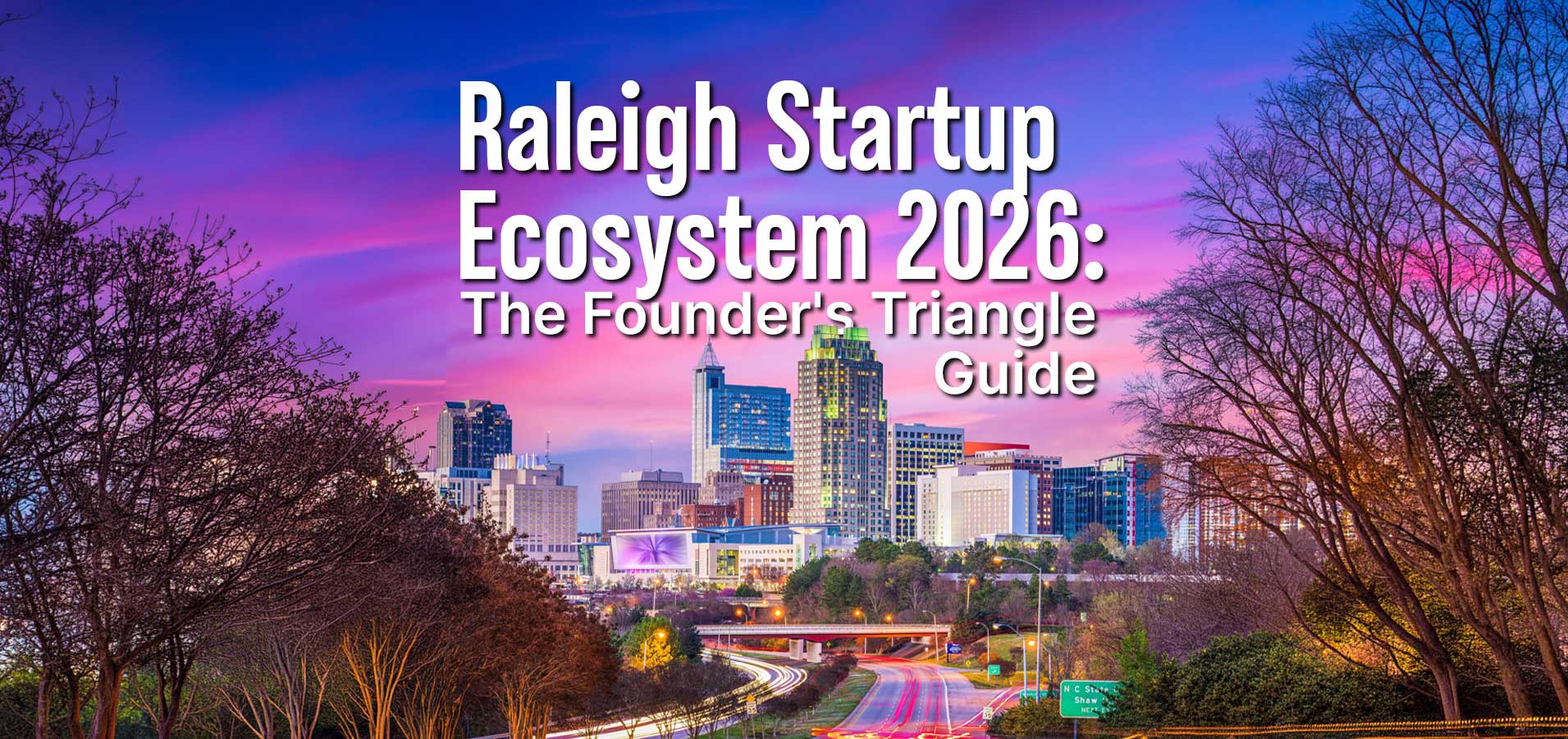
Raleigh Startup Ecosystem 2026: The Founder's Triangle Guide
Raleigh is the named city. The Research Triangle is the real market. In 2026 this is one of the few U.S. metros where you can hire research-grade talent, sit next to wet labs and plants, and keep burn closer to national averages than Bay Area or Boston prices. Life science and advanced manufacturing take most of the venture dollars. Software still works if you sell into those buyers.
This hub page is the map. Use it to understand the city, the specialties that actually matter, and how the Triangle stack works.
What is Raleigh known for as a startup city?
Raleigh is the capital of North Carolina and the eastern corner of the Research Triangle with Durham and Chapel Hill. The specialty is not generic "tech." It is research commercialization: life sciences, gene and cell therapy, medical devices, advanced manufacturing, enterprise software, and applied AI sitting on top of Duke, UNC Chapel Hill, and NC State.
Treat "Raleigh" the way press treats "San Francisco." Headlines often mean the metro. The city is downtown Raleigh, North Hills, and the Wake County corridor. Durham holds a large share of life-science deals. Chapel Hill feeds UNC spinouts. Research Triangle Park sits between them, still about 55,000 workers across 385-plus companies, now adding mixed-use density at Hub RTP and Frontier RTP.
CED's 2025 Venture Report put statewide venture funding at $3.4 billion. The Triangle took 73.2% of the state's deals. Durham led on transaction count (54), Raleigh followed with 29 tech-focused deals, Cary and Morrisville added 17. PitchBook's statewide cut sat closer to $2.3 billion. Use the direction, not fake precision. When a founder needs a U.S. build partner instead of a local hiring sprint, teams such as Foundersbar sit in that gap between idea and a shippable MVP.
Why do founders still choose Raleigh over other U.S. cities?
Founders choose Raleigh when they need research-adjacent talent and buyers without Bay Area burn. Boston has deeper biotech history. Austin has louder software culture. The Triangle's loop is three research universities, a 7,000-acre park, hospital systems that actually pilot, and a cost structure that still lets a two-founder team live near their first customers.
- Capital is concentrating, not disappearing. Statewide dollars rose 7% in 2025 on CED's tally while deal count fell. Average check size rose to about $18.9 million. Q2 2026 spiked to $855.5 million across 26 Triangle deals; five companies took most of the quarter. Mega-rounds dominate. Seed is tighter and more local.
- The sector mix flipped. Life sciences surged 145% to $1.3 billion in 2025. Advanced manufacturing hit $792 million, led by Vulcan Elements. Together those two categories took more than 62% of statewide venture dollars.
- Talent is cheap relative to output. Duke, UNC, and NC State feed the same 30-mile triangle. Mid-level software pay often lands $115k-$145k. Senior local ranges commonly sit $140k-$190k before equity, 15-25% under Bay Area cash.
- Buyers are local. Duke Health, UNC Health, SAS, Red Hat, Cisco, IBM, Lenovo, and a thick CRO / CDMO layer sit inside driving distance. A first pilot can be a 25-minute drive.
- The tradeoff is density. You will not walk past 40 seed funds before lunch. Pure consumer and me-too SaaS raise slower here than in SF. If you need that collision rate in 18 months, this is the wrong city. If you need runway that SF would burn in nine months, stay.
Some pre-seed teams keep a light Raleigh or Durham presence and use a remote product partner for the first build so local dollars go to lab time, pilots, and distribution, not a six-person bench they cannot yet manage.
What is Raleigh's real specialty in 2026?
Raleigh's specialty in 2026 is research-to-company conversion in life sciences and advanced manufacturing, with enterprise software and applied AI as the second layer. Downtown Raleigh still produces software and open-source companies , Red Hat is headquartered here , but the dollars that moved state totals were names such as Kriya Therapeutics ($321 million), Tune Therapeutics, Atsena Therapeutics, Teamworks ($247 million), Restor3d, and Vulcan Elements.
How does the Raleigh startup ecosystem actually work?
The ecosystem is a stacked market: three universities feed talent, CED and a short list of accelerators compress the network, local funds write the first check, national funds show up for the science and the plant, and two downtowns plus the park turn that into weekly collisions. Pick a layer and show up until people remember the company name.
The stack, in order
- Talent: Duke, UNC Chapel Hill, NC State, plus operators leaving Red Hat, SAS, Cisco, IBM, IQVIA, and the hospital systems.
- Formation: CED programs, First Flight Venture Center, Launch Chapel Hill, Techstars Durham, Frontier RTP, university I&E offices.
- Capital: Hatteras and Pappas on life science; Bull City, Cofounders Capital, IDEA Fund, and Front Porch on software; Triangle Angel Partners on the earliest checks; coastal and Charlotte funds on overflow.
- Customers: Hospital systems, CROs, manufacturers, and the enterprise campuses inside RTP and Cary. First ten design partners can all be a drive.
- Services: Startup lawyers who know Delaware + NC, SBIR shops, and build partners for teams that should not hire a full eng org at pre-seed.
Dealroom-powered CED tracking listed more than 3,800 companies. Startup Genome's H2 2023-2025 cut put ecosystem value near $24 billion and early-stage funding at $747 million. Public indexes bounce between a few hundred and 850-plus "active" startups.
Where should a startup sit inside Raleigh and the Triangle?
A software or applied-AI startup should sit in downtown Raleigh. A life-science or hardware company should sit in RTP, Morrisville, or downtown Durham next to labs and hospital systems. Cary works for SAS and west-Wake enterprise buyers. Chapel Hill works for UNC-heavy founding teams.
H1-H2 2026 office data put downtown Raleigh Class A asking rents around $39-$40 per square foot, Research Triangle around $30-$34, and Durham CBD around $35-$37. Delay a long office paper until the team cannot work out of a house, coworking, Frontier RTP, or a customer site.
Neighborhood is strategy, not aesthetics. If your customer is another software company, downtown Raleigh pays for itself. If your customer is a hospital system or a wet-lab partner, RTP or Durham is the correct choice even if the coffee is worse.
How much does it cost to start a company in Raleigh?
A two-founder pre-seed company in Raleigh should plan for burn closer to national averages than San Francisco or Boston , often 30% to 60% lower on housing and 15% to 25% lower on fully loaded engineering. Legal and tools are national-priced. Do not spend the savings on a premature office.
- Personal burn: a one-bedroom in central Raleigh commonly runs about $1,500-$2,050. San Francisco one-bedrooms are often double that.
- First engineer: strong full-stack talent often prices $115k-$145k cash. Senior AI or clinical-software talent climbs toward $160k-$200k.
- Office: delay a private lease. Frontier RTP, downtown coworking, and university space cover year one for most seed teams.
- Build vs. hire: a fixed-scope MVP from a U.S. partner can cost less than one fully loaded local engineer for a year. Use that path for software, not wet work.
The city is not too cheap to take seriously and not cheap enough to waste. Live close to the meetings that matter, and do not hire a platform team because a thread said you needed one.
How do you start a startup in Raleigh step by step?
Incorporate in the U.S., get close to the buyers who live here, raise when the Triangle network helps, and build the smallest product those buyers will pilot. Do not move first and invent the company later.
- Write the wedge in one sentence. If you cannot say who pays and why they switch, RTP will not save you.
- Incorporate as a Delaware C-corp. Assign IP from day one, especially if the idea came out of a university lab.
- Spend two to four weeks in the Triangle before you sign a lease. Take meetings in downtown Raleigh, Durham, and RTP.
- Pick a neighborhood that matches the buyer, not the Instagram map.
- Build an MVP with a hard scope. Local hire, fractional help, or a fixed-cost partner , pick one.
- Run a tight GTM: 20 design-partner conversations, one channel that works, a deck that does not lie about traction.
- Raise when the region is an advantage: CED intros, comparable rounds, a hospital or enterprise logo people here already respect.
Who should not move to Raleigh?
Do not move if your buyers are not in the Southeast, your category only raises in SF-priced AI syndicates, and you need daily Sand Hill collision. Pure consumer social products rarely find a local lead here. The region rewards people who already know the science, the plant, or the enterprise buyer.
How does this connect to a build-and-GTM partner?
Raleigh rewards scoped execution. Life-science buyers will compare your software layer to companies that already raised nine figures. Enterprise buyers here have been through vendor theater. Early teams stall when they spend year one assembling an engineering org instead of putting a scoped product in front of the hospital, plant, or IT buyer they moved here to meet.
Foundersbar is a U.S. tech and marketing hub that takes eligible startups from idea to build to GTM without lighting the raise on an unscoped build. For a Raleigh founder the useful pieces are a blueprint and prototype before code, a fixed-cost MVP, marketing tech for validation, and a fractional CTO when the company is too small for a full-time chief. IP stays with the founder. That maps to Triangle reality: cheaper talent than the coasts, still-expensive mistakes, and investors who will ask who owns the repo.
If you are deciding whether Raleigh is the right base, mapping a vertical that actually gets density in the Triangle, or ready to turn a wedge into a buildable product without lighting the raise on a local bench, start with the relevant spoke above or move to execution planning. The city still rewards a hard scope and buyers you can drive to. It still punishes myth-chasing. For founders who need a development-ready blueprint, a fixed-cost MVP, GTM systems, or fractional technical judgment, partners built for startups rather than enterprise process close the gap between idea and traction.
Raleigh is still good for the companies that need this market , research-adjacent talent, hospital or plant buyers, enterprise software sold into the stack already here. It is a bad default for everyone else. Use the Raleigh startup ecosystem hub as the map, then decide with the cost and hiring pages open. Check eligibility at foundersbar.com.
Frequently Asked Questions
Thinking about building a product or taking it to market?
Thinking about building a product or taking it to market?
Thinking about building a product or taking it to market?
Thinking about building a product or taking it to market?