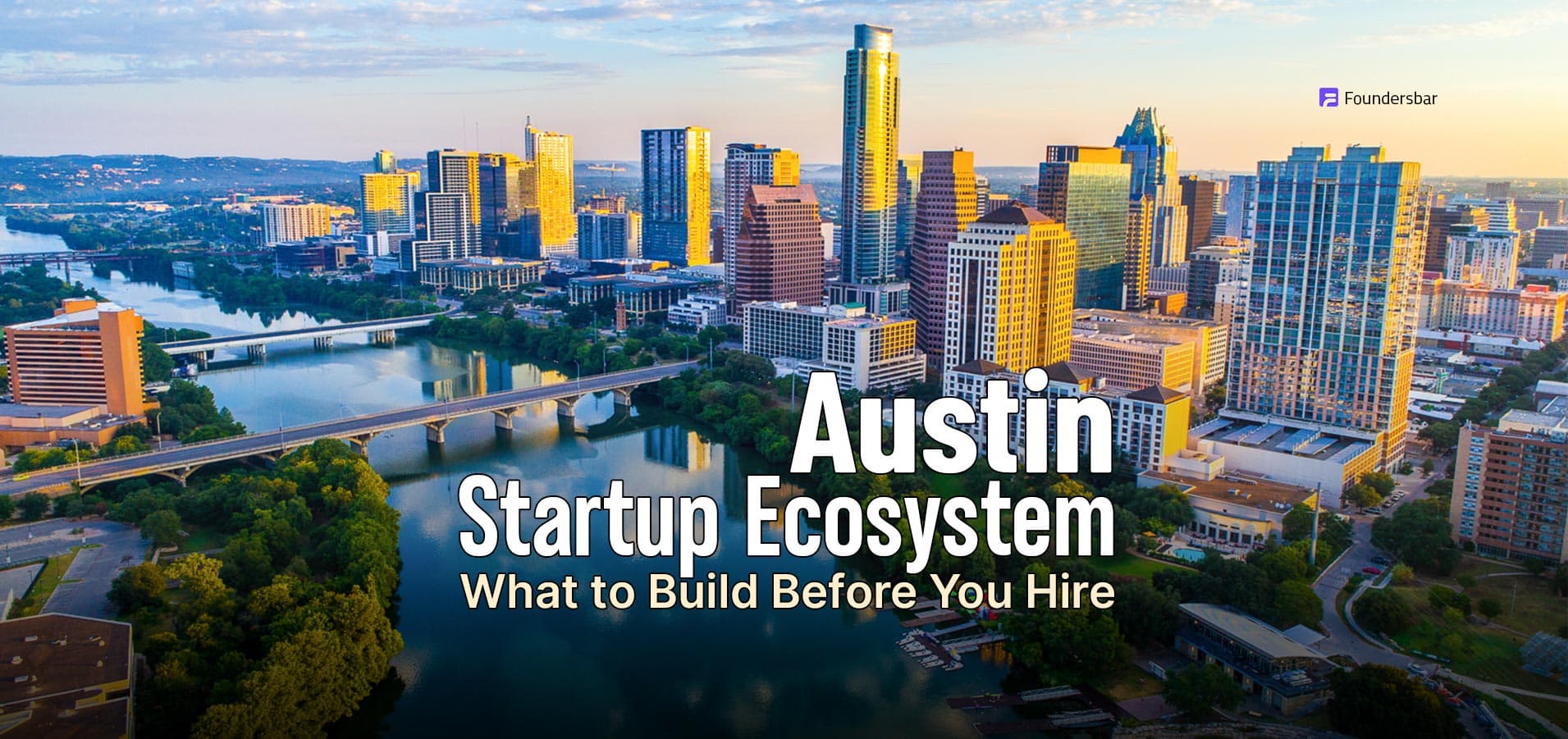
Austin Startup Ecosystem: What to Build Before You Hire
Explore the Austin startup ecosystem through a practical founder-focused guide covering idea validation, product blueprints, MVP costs, engineering teams, tech partners, fractional CTOs, first customers, and startup marketing. Learn how to use Austin’s talent, buyers, capital, and business network strategically while validating demand, building efficiently, and turning an early-stage idea into traction.
Austin Startup Ecosystem: What to Build Before You Hire
Austin will not build the company for you. Campus employers already bid for senior engineers, late-stage rounds hire the people you wanted, and a downtown desk does not create a buyer. The useful path is short: prove someone in Austin will pay, write the spec, ship one workflow, then install a pipeline. A founder who skips a step and “gets more involved in the scene” buys time, not traction.
The eight pages under this hub are the jobs that actually move an Austin company. They are also the jobs a tech-and-marketing partner can take: validate, blueprint, build, judge the vendor, then turn on the pipeline. Read the page that matches the stuck point. Do not read all of them and call that progress.
What does an Austin founder actually need from this city?
A buyer you can meet, and a way to ship before you staff a full engineering bench. Dealroom’s Austin profile puts the funded pool near 2,085 companies, with about 519 founded a year and 183 funded. Crunchbase-reported 2025 funding was $7.19 billion across 272 deals, fewer deals than 2024. Dealroom puts 2025 at $8.1 billion and the first half of 2026 at $5.0 billion. The dollars sit in large AI, robotics, defense, and energy rounds. A first-time founder does not get that check for attending SXSW.
Capital Factory on Brazos is a room and a network. UT Austin and Dell Medical School are talent sources. Tesla, Oracle, Apple’s north campus, and Dell in Round Rock are why senior offers are expensive. None of them write your spec. If the job is still “will anyone use this,” start with validate a startup idea in Austin before you build
How do you validate a startup idea in Austin?
Talk to the buyer before you fund a build. Ten conversations with the person who feels the pain beat a landing page and a waitlist. In Austin that person is often an operator at a software company, a clinic near Dell Med, a plant manager, or a security lead, someone you can sit with, not a persona. If they will not book a second meeting, stop. The full test is validate a startup idea in Austin before you build
Validation is a marketing job, not a pitch-night job. You need the offer in their words, a way to record who said yes, and a kill rule. Foundersbar’s marketing side starts there for eligible teams: validation before GTM spend. Doing it after the MVP is how Austin founders discover the workflow was wrong on a paid invoice.
What should you finish before you hire in Austin?
The buyer, the workflow, and a development-ready blueprint. Hiring first feels local and serious. It is how Austin seed teams burn the runway on a senior engineer who then waits for requirements. A blueprint names the user, the system, the timeline, and the cost before a req opens. That is the page: product blueprint before you hire in Austin
FoundersBar publishes that plan as a blueprint and prototype, starting at $5,000, with requirements, architecture, and a cost estimate a team can build from. For an Austin founder who cannot yet close a lead engineer, that document is the thing you hire against. Check eligibility at foundersbar.com rather than staffing a role you cannot scope.
How do you build in Austin without a local engineering team?
You don’t staff the bench you cannot win. Austin senior cash often sits in a $150,000-$190,000 band, below San Francisco and still high enough to wipe a seed if the spec is fuzzy. Campus employers will outbid a pre-revenue team for the same person. The alternative is a scoped build with a dedicated team, a prototype before code, and the company owning the repository. Full path: build an Austin startup without a local engineering team
A build without a local team still needs an owner on your side. Someone has to accept the prototype, kill a feature, and answer the buyer. That can be you. It should not be a Slack channel with three freelancers and no spec. If you cannot review the architecture, borrow the review before the invoice, not after the repo is a mess.
This is not a plea to avoid Austin talent forever. It is the sequence. Ship the workflow, get a user, then hire the operator who will own it. Reversing that order is how founders end up with a payroll and no product.
How much does an Austin MVP cost?
Scope sets the number. A no-code test can land under $20,000. A lean web workflow often sits in the tens of thousands. A product with accounts, payments, and an admin tool moves past that. Location barely moves it. An unbounded “Austin agency” quote moves it a lot. The working page is MVP cost and scope for Austin startups
A fixed-cost MVP only works after the blueprint. Foundersbar’s published build starts at $35,000, with a dedicated team, a prototype before the build, and a six-month warranty. That is the relevant comparison for an Austin founder staring at a local estimate with no cap. Most scoped MVPs take about 8 to 12 weeks once the plan exists.
Should an Austin founder use a local tech partner?
Use a partner who can show the prototype, the price, and who owns the code. Do not use one because the office is off South Congress. Local shops are booked behind the same late-stage companies that hired the engineers. A zip code does not fix a vague spec. The filter is on how Austin founders choose a tech partner
Ask for IP assignment in the contract, a manager on the work, and a warranty after launch. If the answer is hourly with no ceiling, you are renting confusion. Teams that clear that filter and still need a U.S. build partner often end the search at a startup shop such as Foundersbar, not at the nearest Austin agency.
When does an Austin startup need a fractional CTO?
When a vendor, an architecture choice, or a broken build has to be judged before you can pay a full-time CTO. Austin has operators. It does not have cheap ones, and the good ones are inside Tesla, Oracle, Apple, or a late-stage robotics team. A fractional CTO is the review: stack, ownership, vendor risk, and what not to build. That job is fractional CTO for Austin founders.
It is not a way to avoid a roadmap. Foundersbar’s advisory work is the independent review: technology, IP access, and vendor audits , for eligible teams that need the judgment without the full-time salary. Use it to stop a bad build. Do not use it as a status hire.
How does an Austin startup get its first 10 customers?
Name them before you decorate the round. Ten buyers you can meet in Austin beat a brand film and a conference badge. Energy, industrial software, security, health tools, and mid-market software already have operators in this metro. If you cannot list ten names, the city is not the problem and another intro will not fix it. The sequence sits on how Austin startups get their first 10 customers.
- Write the painful workflow in their words, not yours.
- Put the product in front of five of them before the MVP is “done.”
- Track who came back. A meeting that does not produce a second meeting is a no.
- Only then spend on a site, a list, or paid. The stack page is next, not first.
SXSW is a March sales week if those ten meetings were booked before you flew in. It is not a funding strategy and not a reason to build the product in public with no spec. A booth without a follow-up owner is a costume.
Go-to-market here fails in a specific way. The founder collects cards at a downtown event, sends a deck, and waits. The buyer wanted the workflow in their stack, a price, and a date. Put those three in the first email. The GTM page is where that motion gets written down, including what you do not automate yet.
What marketing stack does an Austin startup need after the raise?
A site that says who it is for, analytics on the workflow, a way to capture the ten buyers, and one paid or outbound motion you can turn off. Founders add a brand studio because the round felt like a launch. The pipeline does not care. Setup belongs on the marketing stack for Austin startups after the raise.
Minimum stack: one page with the buyer and the workflow, product analytics, a CRM or a sheet you actually open, and email that does not come from a personal Gmail. Skip the brand film, the twelve-page site, and a retained agency until someone has paid or piloted. Austin has plenty of shops that will sell you the film.
Validation, go-to-market, and growth are separate jobs. Validation is before the build. GTM is the first ten. Growth is what you turn on after a workflow retains. Mixing them is how Austin teams buy ads for a product nobody finished. Foundersbar deploys that marketing tech with the build for eligible startups, so the stack exists when the product ships instead of three months later.
If you are deciding whether Austin is the right base, mapping a vertical that actually gets density here, or ready to turn a wedge into a buildable product without lighting the raise on a local bench, start with the relevant spoke above or move to execution planning. The city still rewards a hard scope and a buyer you can meet. It still punishes myth-chasing. For founders who need a development-ready blueprint, a fixed-cost MVP, GTM systems, or fractional technical judgment, partners built for startups rather than enterprise process close the gap between idea and traction.
Austin is still good for the companies that need this market. It is a bad default for everyone else. Use the Austin startup ecosystem hub as the map, then decide with the blueprint and MVP pages open. Check eligibility at foundersbar.com.
Frequently Asked Questions
Thinking about building a product or taking it to market?
Thinking about building a product or taking it to market?
Thinking about building a product or taking it to market?
Thinking about building a product or taking it to market?