
HIPAA-compliant healthcare services platform
Transforming an established home care business into a unified digital platform that simplifies booking, improves caregiver coordination, supports healthcare-sensitive workflows, and enables integrated telehealth - all within a single, scalable system.


Overview
A Florida-based home care business wanted to move its operations online. They already had demand. But managing bookings, caregivers, and communication manually was slowing them down. They needed a single platform to handle everything - from booking to care delivery to telehealth.
The Founders Situation
The business was already running successfully, with customers regularly booking care, caregivers actively delivering services, and daily operations functioning smoothly. However, everything relied heavily on manual coordination, making processes time-consuming and harder to manage as demand increased. There was no central system to bring everything together, no real-time visibility into caregiver activity or scheduling, and no scalable workflows to support efficient growth and long-term expansion.
Challenges
1.Offline → digital transition
Turning real-world care delivery into a simple, structured, and usable digital product experience
2.Multiple user roles
Supporting customers, caregivers, doctors, and admins with clearly defined workflows and access
3.Healthcare-sensitive data
Managing patient records, care notes, and data with a disciplined and structured system approach
4.Telehealth integration
Integrating consultations, patient records, and prescriptions into one seamless platform experience
Our Approach
1.Built around real operations
Designed the system around how the business actually operates across daily service workflows
2.Multi-role platform design
Created clear and separate experiences for each user type to reduce overlap and confusion
3.Connected system, not features
Unified booking, care delivery, telehealth, and administration into one cohesive system
4.Technology-side best practices
Implemented structured practices for access control, record handling, and system reliability
What We Delivered
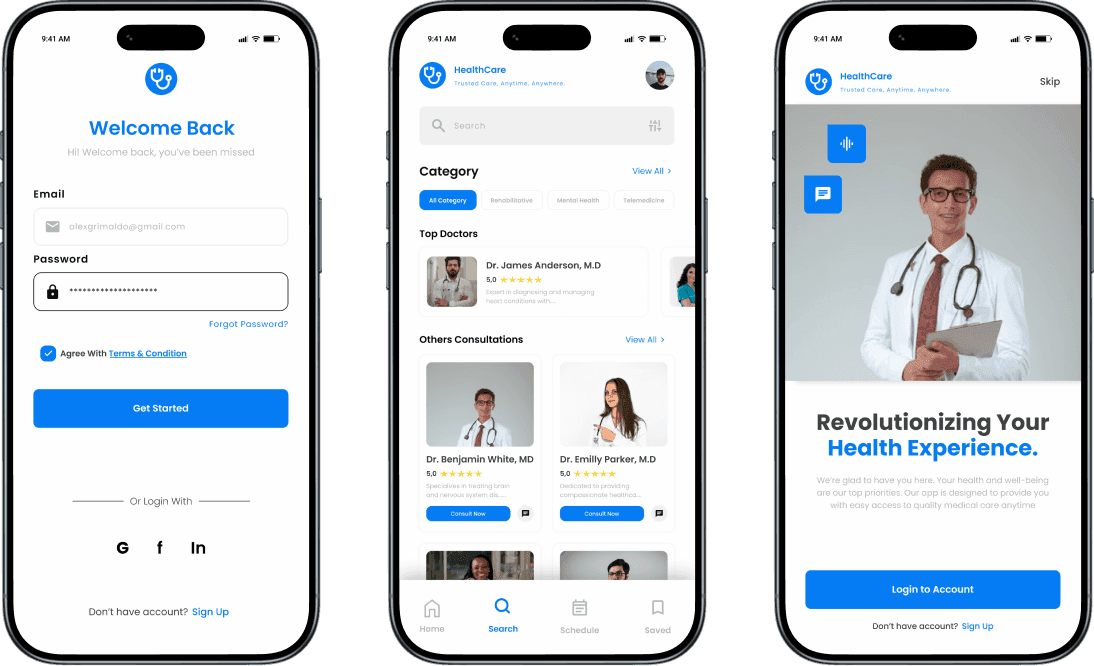
- Customer app for booking, tracking, and service management
- Caregiver app for workflows, tasks, and care note logging
- Telehealth system for consultations and prescription access
- Admin platform for control, visibility, and user management
- Unified system connecting booking, care, telehealth, and admin
5 Months
Delivered ahead of the planned 6-month timeline
$80K
Completed below the initial $100K project budget
Outcome
Foundersbar delivered the project ahead of schedule and under budget, completing it in 5 months instead of the planned 6 months, while optimizing costs from $100K to $80K.
- Transitioned from manual operations to a fully structured digital platform
- Improved booking experience and real-time caregiver visibility for users
- Enabled consistent workflows across care delivery and internal operations
- Successfully integrated telehealth into the core service experience
Conclusion
This engagement helped transform an established offline home care business into a structured digital platform that supports daily operations and future growth. By unifying booking, caregiver workflows, patient records, and telehealth into one system, the client gained better visibility, improved coordination, and a more streamlined service experience. The platform was delivered in 5 months, ahead of the planned 6-month timeline, and completed at $80K against an initial $100K estimate. Beyond delivery, the system was designed with the right technology-side structure to support healthcare-sensitive workflows and long-term scalability.
Healthcare platforms require both delivery discipline and compliant infrastructure. Our fixed cost MVP structure handled the former; our GTM tech setup ensured the product was measurable and launch-ready from day one.
Confidentiality & approval: Client and product names have been redacted on request. This case study was reviewed and approved by the client in this redacted form before publication.
FAQs

A digital healthcare platform connects booking, patient records, caregiver management, and telehealth services into one system to improve efficiency and user experience.
Common challenges include manual processes, fragmented operations, limited visibility, scheduling issues, and difficulty managing multiple users and workflows.
Healthcare platforms use role-based dashboards and secure access controls for patients, caregivers, doctors, and administrators.
Yes, telehealth is a key feature that enables virtual consultations, remote patient interaction, appointment booking, and digital prescription access.
Benefits include faster operations, better coordination, improved patient experience, real-time visibility, and scalable healthcare service delivery.